

PVC soft strip curtains look harmless.
Flexible. Smooth. Easy to bend.
But once they hit a shredder, the story changes fast. The material stretches. Wraps around shafts. Slips between blades. Heat builds up. Production slows. Operators get frustrated. Profit margins get thinner.
I’ve seen this firsthand at Amige. Many recyclers call us after trying standard shredders on PVC curtains and getting disappointing output. Knives dull too quickly. Feeding becomes unstable. Material jams repeatedly. The line stops more than it runs. That hurts throughput and customer confidence. The good news? PVC soft curtain scrap is recyclable. The challenge is mechanical strategy. Once the process is matched correctly, performance becomes stable and profitable.
My short answer is simple: PVC soft strip curtains require controlled torque, optimized blade geometry, stable feeding pressure, and careful heat management. We treat them differently from rigid plastics. At Amige, we typically combine a single-shaft shredder with application-specific rotor knives and downstream granulation. That setup reduces wrapping, improves particle consistency, and keeps output reliable over long production cycles. The material is tough, yes—but with the right engineering, tough becomes manageable.
And honestly?
PVC film and soft curtain waste like to test our patience.
Machines don’t need luck.
They need proper design.
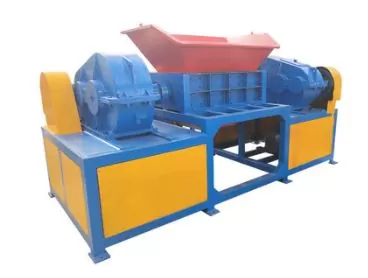
Why Is PVC Soft Curtain Material So Difficult to Shred?
PVC strip curtains have strong elasticity.
That is great for warehouses.
Not great for cutting.
The material bends before it fractures. It absorbs blade impact. It stretches around the rotor. Then it sticks. Then it wraps.
According to Flexible PVC Material Performance Report, flexible PVC elongation can exceed 250% depending on formulation.
That matters.
Because elongation changes cutting behavior.
Higher toughness means higher resistance.
And if the blade angle is wrong?
You end up wrestling plastic instead of processing it.
At Amige, we classify PVC soft curtains differently from rigid PVC pipe or sheet.
Same polymer family.
Completely different mechanical behavior. Two Shaft Shredder For Chemical Drum
What Blade Geometry Works Best for High-Toughness PVC?
This is where engineering pays the bills.
Standard flat-edge knives often grab and drag soft PVC.
Not ideal.
We prefer deeper bite geometry.
Sharper entry.
Controlled clearance.
And stronger wear resistance.
Our team often selects special alloy steel rotor knives designed specifically for flexible plastics.
The blade should pull material inward.
Not bounce it away.
Knife clearance also matters.
Too tight?
Heat rises.
Too loose?
The material slips.
Industry wear testing from Industrial Blade Durability Lab shows optimized clearance can improve cutting efficiency by nearly 20%.
That aligns with what we see on customer lines.
Small adjustment.
Big difference.
Should We Use Single-Shaft or Double-Shaft Shredders?
Good question.
My answer depends on output targets.
For PVC soft strip curtains, I usually recommend single-shaft.
Why?
Because hydraulic pushing keeps feeding consistent.
Rotor speed stays controlled.
Particle size becomes more uniform.
And wrapping is easier to manage.
Double-shaft systems can work.
Especially for bulk feeding.
But soft PVC likes control.
Single-shaft offers better control.
Our customers running warehouse curtain scrap and industrial flexible PVC strips usually see smoother operation with this layout.
Then we add a crusher afterward.
First shred.
Then size reduction.
That combination keeps downstream pelletizing easier.
Simple systems often win.
How Do We Prevent Wrapping Around the Rotor?
Wrapping is the classic headache.
PVC stretches.
Then twists.
Then hugs the rotor like it pays rent there.
To reduce that:
We slow the rotor.
Increase bite strength.
Improve knife arrangement.
Use anti-wrap rotor design.
And balance hydraulic feed pressure.
According to Plastic Recycling Rotor Design Analysis, anti-wrap rotor profiles can reduce downtime by over 30%.
Our own experience?
Very close.
Sometimes better.
We also advise customers to pre-cut oversized curtain rolls.
Less bunching.
More stable feed.
More productive shift hours.
Operators appreciate that.
Managers appreciate it even more.
What About Heat Build-Up During PVC Processing?
Heat matters.
A lot.
PVC is sensitive.
Too much friction creates trouble.
Material softens.
Knives gum up.
Output drops.
Surface quality suffers.
In severe cases, thermal degradation becomes a risk.
That’s why we focus on:
Lower rotor speed.
Sharp blades.
Stable cutting.
Ventilation.
And efficient discharge.
Some customers also add cooling systems depending on capacity.
Our engineering team evaluates this before machine delivery.
Because solving heat after installation costs more.
Solving it before shipment is better business.
Traditional thinking still works here.
Plan early.
Operate steadily.
Avoid surprises.
Can PVC Soft Curtain Scrap Become Valuable Recycled Material?
Absolutely.
That’s the business case.
PVC strip curtain waste can return into useful recycled feedstock.
Ground flakes.
Compounds.
Secondary extrusion applications.
Depending on contamination and formulation.
Market demand for recycled PVC continues to grow according to Global Recycled PVC Outlook.
Customers care about quality consistency.
Particle size.
Clean discharge.
Reliable uptime.
That’s where machinery creates margin.
A recycler earns more when output stays stable.
Less downtime.
Lower knife replacement frequency.
Better material quality.
That adds up fast.
And yes—
PVC can be stubborn.
But stubborn materials often create the best recycling opportunities.
How Do We Configure the Best Amige Solution?
At Amige, we start with material reality.
Not catalog theory.
We ask:
Thickness?
Width?
Contamination?
Hourly capacity?
Target output size?
Then we configure.
For many PVC soft curtain projects, our proven setup includes:
- Single-shaft shredder with hydraulic ram
- Special alloy rotor knives
- Anti-wrap rotor structure
- Conveyor feeding
- Granulator
- Optional cooling
- Optional dust collection
Straightforward.
Reliable.
Easy maintenance.
Built for long-term operation.
That matters in manufacturing.
Fancy machines are easy to sell.
Stable machines are harder to build.
We prefer stable.
Our customers usually do too.
Conclusion
PVC soft strip curtain shredding is demanding. But it is absolutely manageable. With correct blade geometry, controlled feeding, anti-wrap rotor design, and steady heat management, we turn tough flexible PVC into reliable recycled value. That’s how we approach it at Amige—practical engineering, proven results, and machines built to keep running.
