

The shredder was running smoothly last month. Then suddenly, operators started complaining. The noise level increased. Vibrations became noticeable. Production managers worried about bearing failures. Maintenance teams prepared for unexpected downtime. Sound familiar?
In my years of manufacturing plastic shredders at AMIGE, I have seen many customers assume that excessive noise means a major machine failure. Fortunately, that is rarely the case. Most shredder noise problems originate from a few specific components. If identified early, the issue can often be resolved within hours rather than days.
If your shredder becomes unusually noisy, start by checking the blades, bearings, gearbox, rotor balance, hydraulic system, and machine foundation. In most cases, one of these areas is responsible for the abnormal sound. Early inspection not only reduces noise but also extends machine life, lowers maintenance costs, and prevents catastrophic failures. According to industry reports published by Industrial Recycling Equipment Research Center, nearly 70% of shredder noise issues are related to wear, misalignment, or insufficient maintenance.
Ignoring unusual noise is expensive.
Listening to your shredder carefully may save thousands of dollars in repairs.
Why Does Shredder Noise Suddenly Increase?
A shredder is not supposed to be silent.
Large motors, rotating shafts, cutting blades, and material impacts naturally generate sound.
However, when operators notice a significant increase in noise, something has changed inside the machine.
The first step is distinguishing normal operating noise from abnormal mechanical noise.
According to a study from Machinery Condition Monitoring Institute, a sudden increase exceeding 10 dB often indicates developing mechanical problems rather than normal operational variations.
Common warning signs include:
- Metallic knocking
- High-pitched squealing
- Grinding sounds
- Rhythmic impacts
- Excessive vibration
- Gear chatter
Each sound tells a different story.
Learning this language can dramatically improve maintenance efficiency.
Are Worn Blades Creating Excessive Noise?
Blades are usually the first place I check.
Many operators focus on production output while overlooking blade condition.
A dull blade does not cut efficiently.
Instead, it tears, drags, and impacts material repeatedly.
This creates unnecessary vibration and noise.
As blade edges wear down, cutting resistance increases.
The rotor must work harder.
Motor load rises.
Mechanical stress increases throughout the entire drivetrain.
Signs of blade-related noise include:
- Increased material bouncing
- Irregular cutting sounds
- Reduced throughput
- Higher energy consumption
According to data from Plastic Recycling Technology Association, worn blades can increase operational noise by up to 20%.
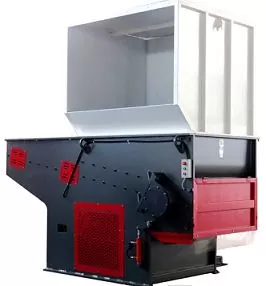
Regular blade inspection remains one of the simplest and most cost-effective maintenance practices. Single Shaft Shredder Machine For LDPE Film
Could the Bearings Be Failing?
If I hear a continuous rumbling sound, bearings immediately become my primary suspect.
Bearings support the rotor.
They endure constant loads, vibration, dust, and contamination.
Over time, lubrication degrades.
Dust enters the housing.
Wear develops.
The result is noise.
Lots of it.
Typical bearing failure symptoms include:
- Low-frequency rumbling
- Grinding sounds
- Elevated temperature
- Excessive vibration
- Lubricant leakage
Modern vibration monitoring systems can detect bearing wear long before catastrophic failure occurs.
According to Predictive Maintenance Analytics Group, more than 40% of rotating equipment failures originate from bearing degradation.
When replacing bearings, always inspect the shaft and bearing housing.
Installing a new bearing into a damaged housing rarely solves the problem.
Is the Gearbox Generating Unwanted Noise?
The gearbox often gets blamed for every strange sound.
Sometimes the gearbox deserves the blame.
Sometimes it does not.
Gearboxes transmit enormous torque.
When gears wear unevenly, tooth contact changes.
This creates gear meshing noise.
Operators often describe it as whining or humming.
Common gearbox issues include:
- Insufficient lubrication
- Contaminated oil
- Worn gear teeth
- Shaft misalignment
- Loose mounting bolts
I recommend oil analysis at scheduled intervals.
A small amount of metal contamination today may prevent a major gearbox rebuild tomorrow.
Many customers discover gearbox issues only after the noise becomes impossible to ignore.
That is usually too late.
Is Rotor Imbalance Causing Vibration and Noise?
A rotor spinning at high speed behaves much like a car tire.
If the weight distribution becomes uneven, vibration follows.
Rotor imbalance is frequently caused by:
- Uneven blade wear
- Material buildup
- Improper blade replacement
- Damaged rotor components
The resulting vibration transfers throughout the machine frame.
Operators hear noise.
Maintenance teams feel vibration.
Bearings suffer.
Gearboxes suffer.
Everyone suffers.
According to Rotating Equipment Engineering Forum, proper rotor balancing can reduce vibration levels by over 50%.
Regular cleaning is surprisingly effective.
I have seen customers eliminate severe vibration simply by removing accumulated plastic residue from the rotor.
Sometimes the solution is not complicated.
It is just dirty.
Have You Checked the Hydraulic System?
Many modern single-shaft shredders use hydraulic pushers.
Hydraulic systems can become unexpected noise sources.
When hydraulic pumps struggle, cavitation may occur.
The sound resembles gravel circulating through pipes.
Not pleasant.
Not healthy.
Potential hydraulic noise causes include:
- Low hydraulic oil level
- Air contamination
- Clogged filters
- Worn pumps
- Damaged valves
Monitoring hydraulic pressure can reveal hidden problems before they escalate.
I always advise customers to include hydraulic inspections during routine maintenance schedules.
The hydraulic system may not be cutting material directly.
But it can certainly make enough noise to attract everyone’s attention.
Could the Machine Foundation Be the Real Problem?
Sometimes the shredder itself is perfectly healthy.
The foundation is not.
Over years of operation, anchor bolts loosen.
Concrete settles.
Structural supports shift.
The machine starts transmitting vibration into the floor.
The floor amplifies the sound.
Suddenly, operators think the shredder is failing.
In reality, the foundation is acting like a giant speaker.
Check for:
- Loose anchor bolts
- Cracked concrete
- Uneven mounting surfaces
- Damaged vibration isolators
A simple foundation inspection often reveals problems hidden in plain sight.
I always tell customers this:
Never diagnose a shredder while ignoring what it is standing on.
Can Preventive Maintenance Eliminate Most Noise Problems?
Absolutely.
Most excessive shredder noise is preventable.
Waiting until a machine becomes loud enough to interrupt conversations is not a maintenance strategy.
It is a repair strategy.
Preventive maintenance should include:
- Daily visual inspections
- Weekly lubrication checks
- Monthly vibration analysis
- Blade wear monitoring
- Gearbox oil testing
- Hydraulic system inspections
- Foundation verification
According to Global Recycling Machinery Maintenance Database, facilities implementing structured preventive maintenance programs reduce unplanned downtime by more than 30%.
That is a significant competitive advantage.
Less downtime.
Lower repair costs.
Longer equipment life.
Better profitability.
Everything a recycling plant wants.
How Do We Approach Noise Troubleshooting at AMIGE?
At AMIGE, we follow a systematic process.
We never guess.
We inspect.
We measure.
We verify.
Our engineers typically evaluate:
- Blade condition
- Bearing temperature
- Vibration spectrum
- Gearbox oil quality
- Rotor balance
- Hydraulic performance
- Structural integrity
This approach allows us to identify root causes quickly.
In many cases, customers expect major repairs.
Instead, they need only a bearing replacement, blade adjustment, or foundation correction.
The earlier the inspection begins, the lower the repair cost becomes.
That principle applies to every shredder, regardless of brand.
Conclusion
Excessive shredder noise is usually a warning, not a disaster. By inspecting blades, bearings, gearboxes, rotor balance, hydraulic systems, and machine foundations, most issues can be identified and corrected quickly. Listen carefully to your shredder today. It may be telling you exactly what needs attention.
