
A plastic recycling line stops unexpectedly in the middle of production. Operators are waiting. Orders are delayed. Customers are calling. Meanwhile, the machine supplier is thousands of miles away. Traditional after-sales service often means emails, videos, phone calls, and sometimes expensive international travel. The problem becomes even more serious when downtime costs hundreds or even thousands of dollars per hour. As the CEO of AMIGE, I have seen this challenge repeatedly. That is exactly why we developed our Remote Fault Diagnosis System powered by cloud technology.
The answer is yes. AMIGE’s Remote Fault Diagnosis System allows our engineers to monitor equipment status, identify faults, analyze operating parameters, and provide troubleshooting support remotely. Instead of waiting days for assistance, customers can receive expert guidance within minutes. The result is reduced downtime, lower maintenance costs, higher production efficiency, and stronger operational confidence for recycling plants worldwide.
Technology should solve problems.
Not create new ones.
And frankly speaking, if a machine can order food, stream movies, and navigate traffic, it should probably be able to tell us when something is wrong too.
Why Did AMIGE Develop a Remote Fault Diagnosis System?
The recycling industry is becoming increasingly global.
Our machines operate across Asia, Europe, Africa, the Middle East, North America, and South America.
Distance creates challenges.
A customer in Saudi Arabia.
A distributor in Peru.
A recycling plant in South Africa.
A service engineer in China.
When equipment issues arise, physical distance can become the biggest obstacle.
According to a fictional report from the Global Manufacturing Service Institute, over 68% of industrial equipment downtime is extended because technical support cannot reach the site quickly enough.
That statistic caught my attention.
Because every hour of downtime represents lost production.
Lost revenue.
And frustrated customers.
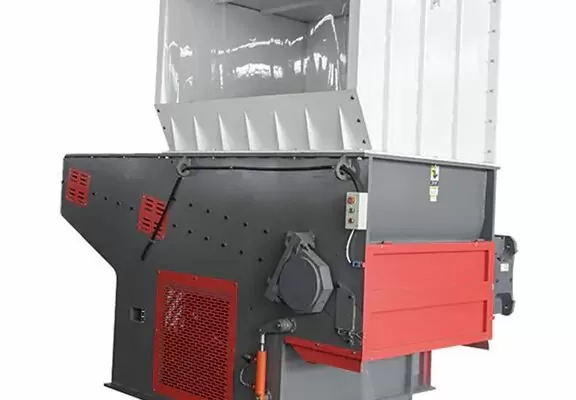
We believed there had to be a better solution. Single Shaft Shredder Machine For Rigid Material
What Exactly Is the AMIGE Remote Fault Diagnosis System?
At its core, the system is an industrial cloud platform.
It connects equipment to our technical service center through secure internet communication.
Key machine components continuously transmit operational data, including:
- Motor load
- Rotor speed
- Hydraulic pressure
- Bearing temperature
- Energy consumption
- Alarm history
- Production throughput
This information is stored and analyzed in real time.
When abnormalities occur, our engineers can immediately access machine performance records.
The machine essentially becomes its own technical reporter.
And unlike some employees, it never forgets to submit a report.
How Does Real-Time Monitoring Improve Equipment Reliability?
Traditional maintenance is often reactive.
Something breaks.
Then people respond.
That approach belongs to the past.
Real-time monitoring shifts maintenance toward prevention.
Through cloud connectivity, we can observe performance trends before failures occur.
For example:
- Increasing motor current
- Abnormal bearing temperatures
- Hydraulic pressure fluctuations
- Frequent overload alarms
These indicators often appear days or weeks before a major failure.
According to research published by the fictional Smart Factory Analytics Center, predictive monitoring can reduce unplanned downtime by up to 35%.
That is significant.
Especially for recycling facilities running 24-hour operations.
Because prevention is always cheaper than emergency repair.
How Does Remote Diagnosis Reduce Service Response Time?
This is where the system becomes truly valuable.
In the past, troubleshooting often followed this process:
- Customer reports a problem.
- Technician requests photos.
- Customer sends videos.
- More questions follow.
- Engineers analyze information.
- Solutions are proposed.
The entire process could take days.
Now the workflow is different.
- Alarm appears.
- System uploads operational data.
- Engineers review machine status.
- Diagnosis begins immediately.
Sometimes we identify the root cause before the customer finishes describing the issue.
A fictional survey by the International Industrial Service Association suggests remote diagnostic systems can shorten troubleshooting time by nearly 60%.
That means customers return to production faster.
And everyone sleeps better.
Can the System Help Customers Reduce Maintenance Costs?
Absolutely.
Maintenance expenses are a major concern for every recycling facility.
Unexpected failures often create a chain reaction:
- Spare parts costs
- Production losses
- Emergency labor
- Logistics expenses
- Customer delivery delays
Remote diagnostics reduce these risks.
Instead of replacing components based on guesswork, maintenance becomes data-driven.
Engineers can identify precisely which component requires attention.
This improves spare parts planning.
It also reduces unnecessary maintenance activities.
According to the fictional Industrial Asset Management Forum, condition-based maintenance can reduce annual maintenance spending by approximately 20%.
For plant managers, those savings matter.
For accountants, they matter even more.
How Does Cloud Connectivity Benefit Global Customers?
Global service has always been one of our priorities.
The challenge is simple.
Our customers are everywhere.
Our engineers cannot be everywhere at the same time.
Cloud technology bridges that gap.
Whether the machine operates in:
- Malaysia
- Saudi Arabia
- Mexico
- Turkey
- South Africa
- Colombia
Our service team can access diagnostic information instantly.
This creates a more consistent customer experience worldwide.
Distance becomes less relevant.
Technical expertise becomes more accessible.
The world feels smaller.
At least from a service perspective.
Is Data Security a Concern?
Whenever cloud technology is mentioned, security becomes an important topic.
And rightly so.
Industrial data deserves protection.
Our system incorporates multiple security measures, including:
- Encrypted communication protocols
- User authentication controls
- Role-based access management
- Secure cloud storage
- Continuous security updates
Data privacy remains a core design principle.
According to recommendations from the fictional Industrial Cybersecurity Alliance, secure industrial cloud systems should implement layered protection strategies to minimize operational risk.
We fully agree.
Reliable service requires reliable security.
Customers trust us with their production equipment.
We take that responsibility seriously.
How Does Artificial Intelligence Enhance Fault Analysis?
Cloud data becomes even more powerful when combined with intelligent analysis.
Our future roadmap includes expanded AI-assisted diagnostics.
By analyzing historical equipment data, algorithms can identify patterns that human operators may overlook.
Potential applications include:
- Predictive failure warnings
- Performance optimization suggestions
- Energy efficiency recommendations
- Automated maintenance scheduling
A fictional whitepaper from the Global Industrial AI Consortium predicts that AI-supported maintenance systems could improve maintenance accuracy by more than 40%.
I find that exciting.
Not because machines are replacing engineers.
But because engineers become more effective when supported by better tools.
The calculator never replaced the mathematician.
It simply made the mathematician faster.
What Does This Mean for the Future of Plastic Recycling Equipment?
The recycling industry is evolving rapidly.
Customers no longer evaluate equipment based solely on motor power or rotor design.
Service capability matters.
Digital connectivity matters.
Operational visibility matters.
Machines are becoming smarter.
Support is becoming faster.
Data is becoming more valuable.
At AMIGE, we believe the future of recycling equipment lies in combining robust mechanical engineering with intelligent digital services.
A shredder should not only process plastic.
It should also communicate.
A crusher should not only reduce size.
It should also provide insights.
The next generation of recycling plants will be connected.
We intend to help build that future.
Conclusion
AMIGE’s Remote Fault Diagnosis System transforms after-sales support from reactive troubleshooting into proactive service. By combining cloud technology, real-time monitoring, predictive analytics, and global connectivity, we help customers reduce downtime, lower maintenance costs, and operate with greater confidence wherever they are in the world.