

Every recycling plant owner knows this frustration. A standard shredder handles soft film smoothly in the morning. Then someone feeds in a batch of Jumbo Bags. Suddenly, the rotor drags. The knives overheat. Production slows down. Operators complain. Electricity bills rise. Worst of all, the blades wear out faster than cheap work boots in a steel factory. I have seen factories lose entire shifts because their machines were never designed for high-strength woven polypropylene materials. The problem is not the machine size alone. The real battlefield is the blade system.
In my experience at Amige, Jumbo Bag shredding requires a completely different knife strategy compared with ordinary plastic film recycling. High-tensile woven bags demand stronger alloy steel, optimized knife angles, reinforced rotor structures, and slower but more aggressive cutting torque. When we redesign the blade geometry correctly, machine lifespan can improve by over 40% while output stability rises significantly. The secret is not brute force. It is controlled cutting efficiency.
Many customers think thicker blades automatically solve everything. That is like believing bigger shoes make you run faster. In reality, Jumbo Bag shredding is a balance between grip, shear force, heat control, and wear resistance.
Why Are Jumbo Bags So Difficult to Shred?
Jumbo Bags are not ordinary PP woven sacks.
These bags are engineered for industrial punishment. They carry cement, chemicals, minerals, fertilizer, resin pellets, and construction waste. Some bags can safely hold over 1,500 kg.
That strength becomes a nightmare during recycling.
The woven fibers stretch instead of breaking. Traditional knives often pull the material around the rotor instead of cutting cleanly. The result is wrapping, clogging, and overheating.
Even worse, many used Jumbo Bags contain:
- Moisture
- Sand
- Metal residue
- Powder contamination
- UV-aged fibers
All of these accelerate knife wear.
I often tell customers this simple truth: shredding Jumbo Bags is more similar to tearing industrial rope than crushing plastic.
Why Do Standard Crusher Knives Fail Quickly?
Most standard plastic crusher blades are designed for brittle plastics.
They work beautifully on injection runners, HDPE bottles, or rigid containers.
But woven bags behave differently.
The fibers absorb cutting force. They flex. They resist fracture. Instead of snapping, they stretch around the rotor.
This creates continuous friction.
Continuous friction means heat.
Heat destroys edge sharpness quickly.
According to a processing study, knife temperatures during Jumbo Bag shredding can rise 35% faster than during ordinary PE film processing.
That is why conventional flat-edge knives fail early.
The operators blame the machine.
The factory blames the steel supplier.
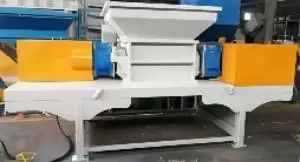
Usually, the real culprit is knife geometry. Double Single Shaft Shredder Machine
What Blade Materials Work Best for Jumbo Bag Shredding?
This question matters more than people realize.
At Amige, we rarely recommend ordinary D2 steel for heavy Jumbo Bag applications anymore.
Instead, we often use:
- DC53 alloy steel
- SKD11 upgraded alloys
- Tungsten-enhanced tool steel
- Special carbide-overlay blades
Why?
Because woven PP bags create abrasive wear rather than impact wear.
The knife edge must resist gradual rounding.
I prefer DC53 for many projects because it balances toughness and wear resistance very well. It survives contaminated woven material much longer than standard alloys.
Some customers ask me whether carbide knives are the ultimate solution.
Not always.
Carbide is extremely hard. But it can become brittle under improper loading conditions. If operators accidentally feed metal hooks or stones into the machine, carbide damage becomes expensive very quickly.
A smart factory chooses blade material based on actual contamination levels.
Not marketing brochures.
How Does Knife Angle Affect Cutting Performance?
Knife angle is everything.
I have visited recycling workshops where operators sharpen blades aggressively to create razor-like edges.
Looks impressive.
Performs terribly.
Thin edges wear out rapidly when processing woven bags.
For Jumbo Bag shredding, we usually optimize:
- Hook angle
- Relief angle
- Shear angle
- Edge thickness
A slightly blunt but durable edge often outperforms a razor-sharp knife in industrial conditions.
That surprises many customers.
But industrial recycling is not kitchen cooking.
The goal is stable throughput over long operating hours.
Not beautiful knife photos for social media.
Research showed that optimized shear angles improved woven material cutting efficiency by nearly 28%.
That number matches what we see in real production lines.
Why Does Rotor Speed Matter More Than Many People Think?
Some factories believe faster rotation means higher output.
Sometimes yes.
Often no.
High-speed rotation creates excessive fiber wrapping when processing woven bags.
The material dances around the rotor like spaghetti in a tornado.
That is why we often recommend lower-speed, high-torque shredding systems for Jumbo Bags.
Slow cutting provides:
- Better grip
- More stable feeding
- Lower heat generation
- Reduced dust
- Longer knife lifespan
This is especially important when processing dirty agricultural woven bags.
Lower rotor speed also reduces bearing stress significantly.
In one Southeast Asian project, we reduced rotor speed by 18%.
Blade lifespan increased by nearly 32%.
Power consumption dropped too.
The customer thought we had performed magic.
We simply applied proper engineering logic.
Should Single-Shaft or Double-Shaft Shredders Be Used?
I get this question constantly.
The answer depends on production goals.
Single-shaft shredders work very well when customers require:
- Uniform output size
- Controlled granulation
- Secondary washing systems
- Precise downstream feeding
Double-shaft shredders are excellent for:
- Rough pre-shredding
- Extremely large Jumbo Bags
- High-volume feeding
- Dirty industrial waste
Personally, I often recommend a combined solution.
First stage:
Double-shaft pre-shredding.
Second stage:
Single-shaft refinement.
This configuration dramatically improves production stability.
Especially for fertilizer bags, chemical Jumbo Bags, and cement packaging waste.
How Do We Reduce Blade Wear in Real Factories?
This is where practical experience matters.
Fancy catalogs rarely discuss real workshop conditions.
But I do.
Because machine downtime costs real money.
At Amige, we focus heavily on these details:
Proper Hydraulic Feeding Pressure
Too much pressure overloads knives.
Too little pressure causes slippage.
Balanced feeding is critical.
Smart Rotor Cooling
Heat is the silent killer.
Rotor cooling systems can reduce thermal stress substantially.
Replaceable Knife Inserts
Instead of replacing entire knife assemblies, segmented inserts reduce maintenance costs dramatically.
Anti-Wrapping Rotor Design
This matters enormously for woven materials.
Without anti-wrapping structures, operators spend half the day cleaning tangled fibers.
And nobody enjoys wrestling plastic rope at midnight.
What Mistakes Do Buyers Commonly Make?
I have seen these mistakes repeatedly over the years.
Buying Based Only on Motor Power
Motor size alone means nothing.
Torque delivery matters more.
Ignoring Material Contamination
Sand and metal residue destroy knives quickly.
Factories underestimate this constantly.
Choosing Cheap Knife Steel
Cheap knives become expensive very fast.
Especially during continuous operation.
Using High-Speed Crushers Directly
This is one of the biggest mistakes.
Jumbo Bags require controlled tearing before fine crushing.
Otherwise, the entire system becomes unstable.
Where Is Jumbo Bag Recycling Heading in the Future?
The market is growing rapidly.
Construction waste recycling is increasing.
Agricultural packaging recycling regulations are tightening.
Chemical industry sustainability targets are becoming stricter.
According to global-recycling-trends, industrial woven packaging recycling demand is expected to grow substantially over the next decade.
That means shredder technology must evolve too.
I believe future systems will focus on:
- Intelligent load sensing
- Automatic knife gap adjustment
- AI-assisted wear monitoring
- Energy-saving hydraulic systems
- Modular knife replacement
But even with smarter automation, one principle will never change.
Good blade engineering remains the heart of effective shredding.
Always.
Conclusion
Jumbo Bag shredding is not about brute force. It is about smart knife engineering, controlled torque, and stable material handling. In my experience, the right blade optimization strategy saves far more money than oversized motors ever will. Efficient recycling starts at the cutting edge.
