

Every day, tons of plastic flexible packaging end up in municipal solid waste streams. Snack bags, shopping bags, stretch films, and multilayer packaging create a nightmare for recycling facilities. They wrap around shafts, clog conveyors, and reduce sorting efficiency. I have visited many recycling plants facing the same challenge. The problem is clear: without proper pre-treatment, downstream sorting and recycling equipment struggle to operate efficiently. The result is lower productivity, higher labor costs, and increased landfill disposal.
The short answer is simple: automated shredding pre-treatment lines transform chaotic plastic soft packaging waste into manageable, uniform-sized material before sorting and recycling. By combining feeding systems, the shredders, magnetic separation, screening, and intelligent conveying, these lines significantly improve sorting accuracy, reduce downtime, and increase overall plant efficiency. In my experience at Amige, a properly designed pre-treatment line often becomes the foundation of a profitable municipal plastic recycling operation.
Many investors focus on optical sorters or washing systems.
I usually tell them the same thing.
If the incoming material is not prepared correctly, even the most expensive sorting technology becomes an expensive decoration.
Why Are Plastic Soft Packages So Difficult to Process?
Plastic flexible packaging is fundamentally different from rigid plastics.
Bottles maintain their shape.
Crates remain stable during transport.
Soft films do neither.
Materials such as LDPE bags, PE film wraps, food pouches, and agricultural films tend to entangle with rotating components.
According to industry reports from Global Plastsic Waste Research Center, flexible packaging represents nearly 40% of plastic waste volume while contributing a much smaller percentage of weight.
This creates major handling challenges.
A truck may appear full, but contain relatively little recoverable mass.
Low bulk density becomes a logistics problem before it even becomes a recycling problem.
What Does a Typical Automated Pre-Treatment Line Include?
When we design a municipal waste plastic shredding line, we rarely start with the shredder.
We start with the material behavior.
A complete automated pre-treatment system generally contains:
- Heavy-duty chain conveyor
- Bag breaker
- Single-shaft or double-shaft shredder
- Magnetic separator
- Trommel screen
- Air classifier
- Intelligent conveying system
- Dust collection unit
- Automated control system
Each component performs a specific task.
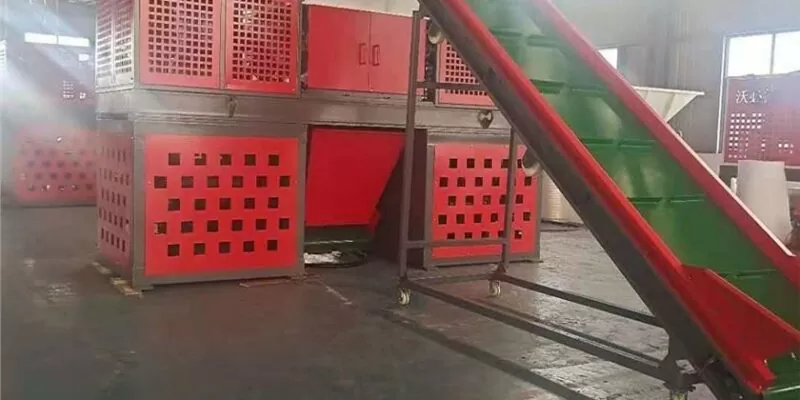
Together, they create a smooth processing flow. Double Single Shaft Shredder For Waste Clothes
Why Is Bag Breaking Important Before Shredding?
Municipal waste often arrives in tightly packed garbage bags.
Many operators attempt to feed these directly into shredders.
That approach usually creates problems.
Bag breakers gently open waste bags without excessive size reduction.
This allows materials to spread evenly across downstream equipment.
Research published by Municipal Waste Processing Institute indicates that pre-opening waste bags can improve sorting efficiency by over 25%.
I have witnessed this improvement firsthand.
When materials remain trapped inside bags, optical sorters cannot identify valuable recyclables.
The bag breaker acts like opening a gift box before sorting the contents.
Except in this case, the gift is recyclable plastic.
How Does Shredding Improve Sorting Performance?
Shredding is not simply about making materials smaller.
Many people misunderstand this.
The goal is controlled size reduction.
Our shredders typically reduce soft packaging waste into particles ranging from 30mm to 100mm depending on downstream requirements.
Uniform particle size offers several advantages:
- Better conveyor transport
- Improved air separation
- More accurate optical sorting
- Reduced material bridging
- Higher throughput stability
According to data from Recycling Equipment Permance Database, facilities utilizing uniform pre-shredding reported up to 35% lower sorting contamination rates.
That number gets attention during investment meetings.
Why Is Automation Becoming Essential?
Labor shortages affect recycling facilities worldwide.
Manual sorting remains expensive.
Consistency is difficult.
Turnover is high.
Automation solves several of these challenges.
Modern PLC-controlled shredding lines can automatically:
- Adjust feed rates
- Monitor motor loads
- Reverse shafts during jams
- Track production output
- Generate maintenance alerts
At Amige, we increasingly integrate intelligent monitoring systems because customers want predictable operation.
Nobody likes discovering a conveyor blockage at 2 a.m.or 3 a.m.
Especially the plant manager.
What Happens After Shredding?
Many people assume shredding completes the job.
Actually, it only starts the separation process.
After shredding, materials typically pass through:
Magnetic Separation
Removes ferrous metals.
Protects downstream equipment.
Improves plastic purity.
Screening Systems
Separate oversized materials.
Ensure consistent particle distribution.
Increase sorting accuracy.
Air Classification
Removes light contaminants.
Separates films from heavier materials.
Improves material quality.
Industry benchmarking data from Advanced Recycling Systems Laboratory suggests air classification can reduce contamination levels by over 15% in mixed waste streams.
How Can Pre-Treatment Increase Recycling Profitability?
This is usually the question investors care about most.
The answer is straightforward.
Better input equals better output.
Higher-quality feedstock creates:
- Higher recovery rates
- Better plastic purity
- Reduced equipment downtime
- Lower maintenance costs
- Improved bale values
A poorly prepared waste stream can dramatically reduce the effectiveness of expensive optical sorting equipment.
I often compare it to feeding whole coconuts into a blender.
The machine is powerful.
But it still expects some preparation.
What Should Recycling Facilities Consider When Choosing a Shredding Line?
Not all waste streams are identical.
The correct configuration depends on:
Material Composition
Municipal waste differs from industrial waste material.
Film-heavy streams require different solutions than rigid plastics material.
Throughput Capacity
A 500 kg/h system and a 10 ton/h system have very different engineering requirements.
Contamination Level
Higher contamination demands stronger separation equipment.
Future Expansion
Many facilities underestimate future growth.
I usually recommend designing for tomorrow’s volume rather than today’s volume.
Expansion costs much less during the planning stage.
How Do We Approach Municipal Plastic Packaging Recycling at Amige?
Our philosophy is simple.
We focus on system integration rather than standalone machines.
A shredder alone does not solve municipal waste material challenges.
An intelligently designed automated line does.
We evaluate material characteristics, contamination levels, throughput targets, and downstream requirements before recommending equipment.
That approach has helped many recycling facilities improve operational efficiency while reducing manual labor dependency.
Most importantly, it helps transform difficult-to-handle plastic flexible packaging into valuable recyclable resources.
Conclusion
Plastic flexible packaging presents unique recycling challenges, but automated shredding pre-treatment lines provide an effective solution. By combining bag opening, controlled shredding, separation, and intelligent automation, recycling facilities can improve efficiency, reduce costs, and maximize material recovery while preparing for future growth.
