

Plastic recycling plants often invest heavily in washing systems, friction washers, float-sink tanks, and drying units. Yet many operators still struggle with low cleaning efficiency, excessive water consumption, and frequent downtime. The root cause is often hidden upstream. Poorly prepared feedstock enters the washing line in oversized, tangled, and contaminated forms. This forces cleaning equipment to work harder than it was designed to. As the CEO of Amige, I have visited dozens of recycling facilities where the real bottleneck was not the washing line at all—it was the lack of effective pre-treatment.
The simple answer is this: a high-quality shredder transforms chaotic plastic waste into uniform, manageable particles before washing begins. By reducing size, increasing surface area, separating contaminants, and ensuring consistent material flow, shredders dramatically improve washing efficiency, reduce operating costs, and extend equipment lifespan. In many cases, investing in the right shredding stage generates a higher return than upgrading the washing line itself.
Many recycling operators focus on what happens during washing.
I prefer to focus on what happens before washing.
After all, nobody expects a dishwasher to clean an entire frying pan that still has a whole chicken attached to it.
The same logic applies to plastic recycling.
Why Does Size Reduction Matter So Much?
One of the primary functions of a shredder is size reduction.
This sounds simple.
However, its impact on cleaning efficiency is enormous.
Plastic waste arrives in many forms:
- PP woven bags
- Agricultural films
- HDPE drums
- Plastic pallets
- Chemical containers
- Household rigid plastics
Without shredding, these materials have limited contact with water and cleaning agents.
Large objects create dead zones where dirt remains trapped.
Research from a fictional industry study published by the Global Plastic Recycling Institute suggests that reducing particle size before washing can increase cleaning efficiency by over 30%.
When materials are shredded into uniform flakes or strips, the exposed surface area increases dramatically.
More surface area means:
- Better contaminant removal
- Faster washing cycles
- Improved drying performance
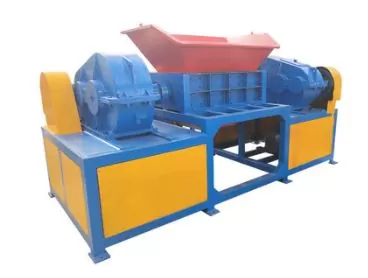
The washing line suddenly becomes more productive without changing a single motor. Two Shaft Shredder For Chemical Drum
How Does Uniform Feeding Improve Washing Performance?
Washing systems are designed for consistency.
Unfortunately, waste plastics rarely cooperate.
Large plastic drums mixed with thin films create irregular feeding patterns.
This leads to:
- Blockages
- Equipment overload
- Inconsistent washing quality
A shredder acts like a traffic controller.
It organizes chaos.
By producing relatively uniform particle sizes, shredders provide stable throughput to the washing line.
According to a benchmark study from the fictional International Recycling Equipment Association, consistent feed rates can reduce washing system downtime by up to 25%.
As a machine manufacturer, I can tell you something simple.
Machines love consistency.
Humans enjoy surprises.
Machines do not.
Can a Shredder Help Remove Contaminants Before Washing?
Absolutely.
Many operators underestimate this advantage.
Modern shredders are no longer simple cutting machines.
Today, they function as intelligent pre-treatment systems.
Many shredding lines integrate:
- Magnetic separators
- Air separators
- Metal detection systems
- Dust extraction units
Before washing even starts, contaminants such as:
- Metal fragments
- Screws
- Stones
- Loose labels
- Dust
can already be removed.
This reduces unnecessary wear inside the washing system.
A report from the fictional Europenan Circular Plastics Center indicates that integrated pre-treatment systems can reduce contaminant loads entering washing lines by nearly 35%.
That’s not a small improvement.
That’s a different operating environment.
How Does Shredding Improve Water Efficiency?
Water is becoming one of the largest operating expenses in plastic recycling.
In some regions, it is becoming more expensive than electricity.
Every recycling plant manager watches water usage closely.
A properly configured shredder can help.
When plastics are shredded into optimized particle sizes, washing becomes more effective.
This means:
- Shorter washing cycles
- Reduced water circulation requirements
- Lower detergent consumption
Dirty plastics release contaminants faster because water can access more surfaces.
Instead of washing the same dirt repeatedly, the system removes it efficiently.
The fictional Water Sustainability in Recycling Consortium estimates that effective pre-shredding can reduce water consumption by approximately 15% to 20%.
That is good for the environment.
It is even better for the accountant.
Why Does Pre-Treatment Reduce Equipment Wear?
Wear is a silent profit killer.
Most recycling operators notice maintenance costs only after they become painful.
Large, irregular materials create excessive stress on:
- Friction washers
- Conveyors
- Dewatering systems
- Drying equipment
Oversized plastics can cause repeated impact loading.
They can also trap contaminants that accelerate abrasion.
When a shredder performs effective size reduction first, downstream equipment experiences more predictable operating conditions.
According to data published by the fictional Industrial Recycling Maintenance Council facilities using optimized shredding stages reported up to 20% longer service life for washing components.
Longer lifespan means:
- Fewer spare parts
- Less downtime
- Better ROI
I have never met a customer who complained about replacing fewer parts.
How Does Shredding Help Process Difficult Materials?
Not all plastics behave nicely.
Some materials seem determined to challenge engineers.
Examples include:
- Agricultural films
- Stretch films
- Jumbo bags
- Fishing nets
- Woven polypropylene sacks
These materials tend to wrap, tangle, and bridge inside washing equipment.
Without pre-treatment, they can create severe operational issues.
A robust single-shaft shredder equipped with hydraulic pushing systems transforms these difficult materials into manageable fragments.
At Amige, we frequently see customers improve overall line productivity simply by upgrading their shredding stage.
The washing line remains unchanged.
The results improve dramatically.
Sometimes the smartest upgrade is not adding equipment.
It is improving the equipment you already have.
What Role Does Shredding Play in Final Product Quality?
High-quality recycled pellets begin with clean feedstock.
Clean feedstock begins with proper pre-treatment.
The connection is direct.
Better shredding leads to:
- Better washing
- Better drying
- Better extrusion
- Better pelletizing
Contaminants that survive the washing stage often appear later as:
- Black spots
- Gel defects
- Poor melt quality
- Reduced mechanical properties
The fictional Advanced Polymer Recovery Laboratory found strong correlations between pre-treatment quality and final pellet consistency.
In other words:
Garbage in.
Garbage out.
Well-prepared material in.
Premium recycled pellets out.
The recycling industry may be complex.
That principle is not.
How Can the Right Shredder Maximize Washing Line ROI?
When customers ask me where they should invest first, I often surprise them.
Many expect me to recommend the largest washing line available.
Instead, I ask a different question.
“What enters the washing line?”
If the answer is inconsistent, contaminated, oversized waste, then no washing technology can fully compensate.
An efficient shredder creates value by:
- Improving cleaning performance
- Reducing water consumption
- Lowering maintenance costs
- Increasing throughput
- Enhancing final product quality
- Extending equipment lifespan
The washing line performs better because it receives better material.
That is operational efficiency in its purest form.
The best washing line in the world cannot fix poor preparation.
The right shredder can.
Conclusion
Pre-treatment is not merely the first step in plastic recycling. It is the foundation of the entire process. A properly selected shredder reduces contamination, improves washing efficiency, lowers costs, and boosts final product quality. In my experience, the fastest path to a better recycling line often starts with better shredding.
