

A plastic grinder reduces rigid plastic scrap into controlled regrind by cutting material between rotating rotor knives and fixed knives. A perforated screen keeps oversized pieces inside the cutting chamber until they are small enough to pass.
In the plastics industry, “grinder,” “crusher,” and “granulator” are often used for the same high-speed knife-based machine. The correct configuration depends on the material, feed dimensions, wall thickness, contamination, required flake size, and downstream process.
I’m Jacky, CEO of AMIGE. I do not select a grinder from motor power alone. Hopper design, rotor type, knife geometry, cutting gap, screen, bearings, feeding method, discharge, noise control, and access for cleaning all affect real output and lifetime cost.
How a plastic grinder works at a glance
| Stage | What happens | What controls performance |
|---|---|---|
| Feeding | Scrap enters through the hopper or conveyor. | Feed size, hopper angle, bridging, and metal protection |
| Cutting | Rotor knives pass fixed knives and shear the plastic. | Knife profile, sharpness, gap, rotor speed |
| Recirculation | Oversized pieces remain in the chamber. | Rotor design and chamber geometry |
| Screening | Material exits when it passes the screen openings. | Hole size, open area, and screen condition |
| Discharge | Regrind moves to a bin, blower, conveyor, or washing line. | Airflow, dust, fines, and downstream capacity |
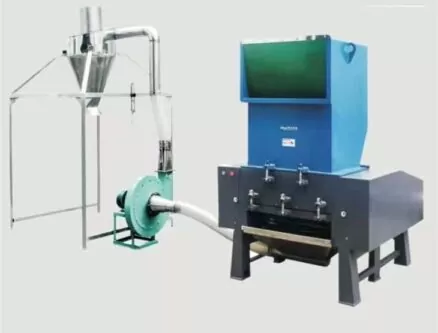
What are the main parts of a plastic grinding machine?
- Hopper: guides material and helps prevent contact with the cutting chamber.
- Rotor and rotor knives: provide the moving cutting action.
- Fixed or bed knives: form the stationary cutting edge.
- Screen: controls the maximum discharge size.
- Motor and transmission: deliver speed and torque to the rotor.
- Cutting chamber and bearings: support alignment and absorb operating loads.
- Discharge system: removes regrind without restricting capacity.
- Controls and safety interlocks: protect the machine and operators.
How do rotor and fixed knives produce regrind?
The rotating knives pass close to stationary knives and create a shearing cut. Correct clearance improves cutting efficiency and helps control fines, heat, noise, and energy consumption. Dull knives or an incorrect gap can tear, beat, or heat the material instead of cutting it cleanly.
Rotor design should match the scrap. Pipes, thick purgings, bottles, film, woven bags, sprues, and thin sheet behave differently in the chamber. Some oversized or bulky materials need a slow-speed shredder before granulation.
How does screen size affect output?
The screen does not create perfectly identical flakes. It limits the maximum size that can leave the chamber. Smaller openings usually increase residence time and may increase heat, fines, wear, and power demand. Larger openings improve flow but produce coarser regrind.
Select screen size from the next process. Washing, conveying, dosing, extrusion, and molding equipment may each require a different particle-size range.
What is the difference between a grinder, shredder, and pulverizer?
| Machine | Typical action | Typical output | Best use |
|---|---|---|---|
| Shredder | Low-speed, high-torque tearing or cutting | Coarse pieces | Bulky, dense, baled, or difficult feed |
| Grinder / crusher / granulator | High-speed shearing with rotor and fixed knives | Screen-controlled regrind | Controlled flakes for washing or reprocessing |
| Pulverizer | Fine grinding between discs or specialized tools | Powder | PVC regrind, rotomolding powder, selected rigid plastics |
For a deeper comparison, see how a plastic granulator works and review available plastic crusher configurations.
Which plastics can an industrial grinder process?
Common applications include PE, PP, PET, PVC, ABS, PS, PC, PA, bottles, crates, pipes, profiles, sheets, sprues, runners, films, and molded rejects. Suitability depends on thickness, temperature sensitivity, reinforcement, metal, mineral content, moisture, and contamination.
Glass-filled plastics, abrasive contamination, thick purgings, and large pipes require special knife materials, wear protection, feeding, or multi-stage reduction. Test representative material before fixing capacity.
What determines plastic grinder capacity?
- Material type, toughness, thickness, and temperature.
- Feed dimensions, bulk density, and feeding consistency.
- Rotor diameter, width, speed, inertia, and knife rows.
- Knife sharpness, geometry, and cutting clearance.
- Screen opening and open area.
- Motor load, discharge airflow, and downstream capacity.
- Contamination, moisture, and required output quality.
Which safety and maintenance features matter?
Specify guarded feeding, electrical interlocks, emergency stops, overload protection, rotor stopping time, safe screen access, lifting assistance, and lockout procedures. Never reach into the hopper or open the chamber until energy is isolated and rotor movement has stopped.
Maintenance should include knife inspection, correct sharpening as matched sets, cutting-gap adjustment, screen inspection, bearing and belt checks, chamber cleaning, and removal of metal before it reaches the rotor.
What information should buyers provide?
- Polymer, product source, photos, samples, and maximum dimensions.
- Wall thickness, bulk density, temperature, moisture, and contamination.
- Required flake size and allowable fines.
- Target saleable capacity and operating hours.
- Feeding, metal protection, discharge, washing, and dust-control requirements.
- Voltage, factory layout, noise target, and destination.
Request a plastic grinder recommendation
Send AMIGE your material photos or samples, maximum feed size, target regrind, capacity, and downstream process. We can recommend the rotor, knives, screen, drive, feeding, and discharge through our plastic grinder quotation form.
Frequently asked questions
How does a plastic grinder work?
Rotor knives shear plastic against fixed knives. A screen retains oversized material until it is small enough to leave the cutting chamber.
Is a plastic grinder the same as a granulator?
In many plastics markets the terms describe the same high-speed knife machine. Confirm the cutting action, rotor, knives, screen, feed, and output rather than relying on the name.
What size flakes does a plastic grinder produce?
Output depends on the screen, knives, material, and operating conditions. The screen limits maximum discharge size but does not make every particle identical.
Can a grinder process film and rigid plastic?
Yes, with the correct rotor, hopper, knives, screen, and feeding. Thin film and thick rigid scrap usually require different configurations.
What affects the price of a plastic grinding machine?
Rotor and chamber size, drive, knife material, screen, hopper, feeding, discharge, soundproofing, controls, wear protection, spares, and delivery scope affect price.
Conclusion
A plastic grinder produces controlled regrind by shearing material between rotor and fixed knives and retaining it behind a sizing screen. Select the machine from the actual scrap and downstream requirement, then verify output with a representative test.
