
The purpose of a plastic granulator machine is to cut suitable plastic scrap into controlled flakes or regrind. Rotating knives pass close to stationary knives, while a screen retains oversized pieces until they are small enough to discharge.
A granulator is not the same as a pelletizer. A granulator performs mechanical size reduction. A pelletizing line melts filtered plastic and cuts the extrudate into pellets. Calling both outputs “granules” often causes expensive equipment misunderstandings.
I’m Jacky, CEO of AMIGE. Before recommending a granulator, I ask about the material form, maximum dimensions, contamination, capacity and the flake specification required by the next process.
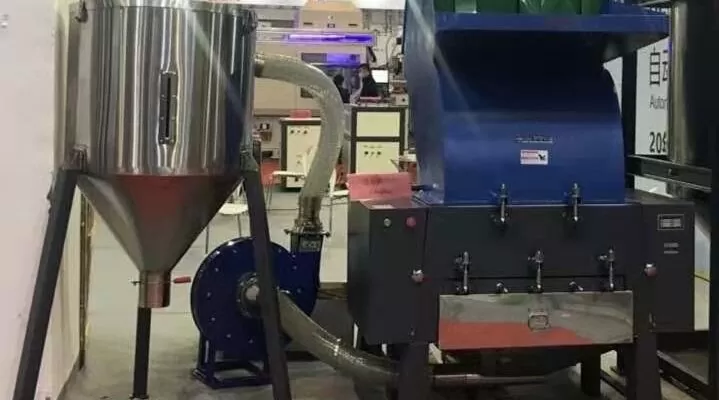
What Does a Plastic Granulator Produce?
A granulator normally produces irregular flakes within a screen-controlled range. These flakes may be washed, separated, dried, blended, conveyed to an extruder or returned to molding when the material and quality specification permit.
The machine does not identify polymers, remove contamination or guarantee that the output is reusable. Sorting, cleaning and quality control remain part of the recycling process.
How a Plastic Granulator Works
| Component | Function | Buyer check |
|---|---|---|
| Hopper | Guides feed while limiting access and kickback | Match maximum part dimensions |
| Rotor | Carries moving knives through the cutting chamber | Choose geometry for rigid or flexible feed |
| Bed knives | Create the stationary cutting edge | Review adjustment and replacement access |
| Screen | Controls retention and maximum discharge size | Balance flake target with capacity and heat |
| Drive | Supplies power and absorbs load changes | Confirm starting and overload protection |
| Discharge | Moves regrind to the next stage | Avoid backup and uncontrolled dust |
When Is a Granulator Used in Recycling?
- Injection-molding sprues, runners and rejected parts
- PET or HDPE bottles entering a washing process
- Rigid PP crates, containers and production scrap
- Pipes, profiles and sheets prepared to fit the hopper
- Selected film or woven material with a suitable rotor and feeder
- Pre-shredded lumps or bulky scrap needing smaller flakes
The same granulator configuration does not suit every item on this list. Flexible film, long profiles and thick purgings create different feeding and cutting demands.
Granulator Versus Shredder
A shredder generally operates at lower speed and higher torque. It is better for bulky, dense or difficult feed and produces coarse pieces. A granulator runs faster and produces smaller, screen-controlled flakes.
Some lines use only a granulator. Others need a shredder first to protect the high-speed machine and stabilize feeding. Adding an unnecessary stage increases cost, footprint and maintenance, so representative testing matters.
Granulator Versus Pelletizer
A granulator cuts solid plastic without melting it. A pelletizer is part of an extrusion line that heats, mixes, filters and forms pellets. Clean granulator regrind can become pelletizer feed, but the two machines perform different jobs.
See the AMIGE plastic granulator machine for a recycling size-reduction platform and our guide on how a plastic granulator works for additional process detail.
What Determines Capacity and Flake Quality?
- Polymer, toughness, wall thickness and temperature
- Part dimensions, bulk density and feeding stability
- Rotor diameter, speed and knife arrangement
- Knife material, sharpness and clearance
- Screen opening and open area
- Motor, drive and overload controls
- Contamination, moisture and discharge method
A smaller screen may improve maximum flake control but usually increases retention, heat, fines, wear and energy per ton. Capacity must be compared using the same material and output requirement.
Safety and Maintenance Priorities
Use guarded feeding and discharge, interlocked access, overload protection and a site lockout/tagout procedure. Never reach into the hopper or clear a jam while energy is available.
Inspect knives, clearances, screen, fasteners, bearings, belts and seals. Trend motor current, sound, vibration and temperature so abnormal wear can be corrected before a major breakdown.
Information Needed for Granulator Selection
Send material photos or samples, polymer, maximum dimensions and thickness, contamination, moisture, bulk density, hourly capacity, target flake, downstream process, operating hours, voltage and layout.
Use the AMIGE inquiry form to request a machine review. We can compare direct granulation with shredder-plus-granulator processing for the actual feed.
Frequently Asked Questions
What is the main purpose of a plastic granulator?
It cuts suitable plastic scrap into screen-controlled flakes for washing, conveying, extrusion, molding or other downstream use.
Is a granulator the same as a pelletizer?
No. A granulator cuts solid plastic into flakes, while a pelletizing line melts and forms plastic into pellets.
Does plastic need to be shredded before granulation?
Only when the parts, bales or lumps are too bulky or unstable for safe direct feeding into the granulator.
Does a smaller granulator screen increase capacity?
Usually not. It increases retention and may raise heat, wear, fines and energy consumption while reducing throughput.
What information is needed to select a granulator?
Provide the polymer, feed dimensions, contamination, capacity, target flake, operating hours, downstream process, utilities and layout.