

Your PET bottle washing line is running. The crusher works. The washing tanks are operating. The dryer is producing flakes. But when you inspect the final recycled PET, you still find label fragments, adhesive residues, and unwanted particles.
For recycling plant owners, this is frustrating. Contamination can reduce product quality, increase filtration requirements, and limit selling opportunities. Some companies immediately consider buying a larger washing machine. However, after years of working with plastic recycling equipment at AMIGE, I have learned that the problem often comes from several processing stages working poorly together.
Labels and glue remain in recycled PET flakes when bottle preparation, label removal, crushing, hot washing, friction cleaning, and separation are not properly matched. An efficient PET Bottle Washing Line must remove contaminants step by step rather than relying on one washing machine. At AMIGE, we evaluate the complete process, including material condition, crushing size, washing temperature, residence time, separation efficiency, and drying performance, before recommending equipment upgrades.
A washing tank cannot solve every contamination problem.
Neither can a powerful crusher.
Clean PET flakes require the right process.

Why Are Labels Still Present After PET Bottle Washing?
PET bottles arrive at recycling plants with different labels.
Common examples include:
- PP labels
- PE labels
- Paper labels
- PVC shrink sleeves
- PET-based shrink sleeves
- Adhesive-backed labels
These materials behave differently during recycling.
Some labels can be removed mechanically before crushing.
Others remain attached to bottles or break into small pieces.
PVC contamination is particularly concerning because PVC and PET have different thermal processing characteristics. Even small amounts of incompatible polymers can affect recycled PET quality.
That is why I recommend examining label composition before selecting a PET Bottle Recycling Machine.
A good recycling process begins with understanding what is attached to the bottle.
PET Bottle Crushing, Washing & Flake Recycling Line
How Does a Label Remover Improve PET Recycling Efficiency?
A mechanical label remover is commonly installed before crushing.
Its purpose is to detach a substantial portion of labels while bottles are still relatively intact.
This can reduce the amount of label material entering the crusher and subsequent washing equipment.
Potential advantages include:
- Lower label contamination
- Reduced downstream cleaning load
- Better material preparation
- Improved separation conditions
However, a label remover cannot guarantee complete removal.
Performance depends on bottle condition, label type, adhesive strength, equipment settings, and feeding rate.
For difficult shrink sleeves, additional sorting or separation may be necessary.


Can Incorrect Crushing Size Increase Label Contamination?
Yes.
The PET Bottle Crusher plays an important role in material preparation.
If crushing produces highly irregular flakes, downstream washing and separation may become less consistent.
Large pieces may retain attached label fragments.
Excessive fines can complicate material recovery and water treatment.
At AMIGE, we consider:
- Rotor design
- Blade condition
- Screen opening
- Material feeding
- Required flake size
The goal is not simply producing the smallest possible PET flakes.
It is producing material suitable for efficient washing and separation.
A properly selected crusher supports the entire recycling process.
Plastic Crusher for PET Bottle Recycling
Why Does Glue Remain on PET Flakes After Washing?
Adhesive contamination is more complicated than loose labels.
Glue can remain attached to PET surfaces even after the visible label has been removed.
Different adhesive formulations respond differently to temperature, mechanical action, and washing chemistry.
Common problems include:
- Insufficient washing temperature
- Inadequate residence time
- Unsuitable cleaning chemistry
- Poor mechanical agitation
- Excessive contamination loading
- Inadequate rinsing
This is why cold washing alone may not remove certain adhesives effectively.
For heavily contaminated PET bottles, an appropriately designed hot washing stage may be necessary.
The correct operating conditions should be established through material testing.
How Does Hot Washing Improve PET Flake Quality?
A PET Hot Washing System uses controlled temperature, washing chemistry where required, and mechanical action to remove difficult contamination.
It may help remove:
- Adhesive residues
- Oil contamination
- Organic deposits
- Certain label residues
- Surface dirt
But higher temperature is not automatically better.
Excessive chemical concentration, unsuitable temperature, or excessive residence time can create operational problems and may negatively affect material quality.
For that reason, I do not recommend one universal washing temperature or chemical dosage for every PET recycling project.
We first need to understand the bottles and contaminants.
Then we establish suitable processing conditions.

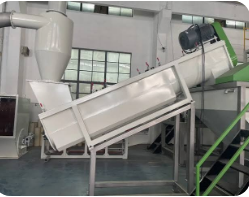
Why Is Friction Washing Important After Hot Washing?
Hot washing helps loosen contamination.
Friction washing helps remove it from the flake surfaces.
A high-speed friction washer uses mechanical action and water flow to separate loosened dirt, adhesives, and other residues.
Its performance depends on:
- Rotor design
- Operating speed
- Water flow
- Material loading
- Residence time
- Screen condition
If the washer is overloaded, cleaning performance may decline.
If water circulation is inadequate, removed contaminants may remain in the process.
A properly configured friction washer helps prepare cleaner flakes for subsequent rinsing and separation.
Can Sink-Float Separation Remove All Labels?
No.
A sink-float separation tank uses density differences.
PET normally sinks in water, while many PE and PP label materials float.
This makes density separation useful for removing certain contaminants.
However, not every label material floats.
PVC and some PET-based label materials may sink with PET.
Attached labels and irregular particles can also reduce separation effectiveness.
Therefore, sink-float separation should be considered one part of a complete PET Flake Cleaning System.
It cannot replace effective label removal, sorting, and washing.
PET Bottle Recycling Machine for Waste Bottle-to-Flake Processing
Why Does Water Quality Affect Final PET Flake Purity?
Clean washing equipment cannot perform consistently with heavily contaminated process water.
Poor water management may cause removed dirt and adhesive residues to circulate through the system.
Important considerations include:
- Water filtration
- Suspended solids
- Chemical concentration
- Water replacement
- Rinsing efficiency
- Wastewater treatment
For larger recycling projects, water circulation and treatment should be designed together with the washing line.
The objective is not simply using more water.
It is maintaining suitable washing conditions while managing operating costs.


How Can Recycling Plants Improve PET Washing Line Performance?
Before purchasing new equipment, I recommend checking the existing production process.
Start with the incoming material.
Are bottles properly sorted?
Are PVC bottles and incompatible labels being removed?
Then examine the processing stages:
Sorting → Label Removal → Crushing → Hot Washing → Friction Washing → Sink-Float Separation → Rinsing → Dewatering → Drying
The exact sequence may vary according to the feedstock and line design.
Measure contamination at several points rather than inspecting only the final flakes.
This helps identify whether the main problem comes from label removal, crushing, washing, separation, or water management.
Sometimes an adjustment is sufficient.
Sometimes an additional cleaning stage is necessary.
And sometimes the existing equipment is simply not suitable for the incoming material.
Industrial PET Washing Machine for Recycled PET Flake Cleaning
What Should Buyers Confirm Before Purchasing a PET Bottle Washing Line?
Before recommending a PET Recycling Washing Line, we normally ask customers for:
- PET bottle photos or videos
- Bottle source and condition
- Label materials
- Glue contamination level
- PVC or other polymer contamination
- Required processing capacity
- Target flake quality
- Available water and wastewater facilities
- Local voltage
- Factory layout
For example:
“We process post-consumer PET bottles with shrink labels and adhesive contamination. Our target capacity is 1,000 kg/h, and we need clean flakes for downstream pelletizing.”
That information is much more useful than simply requesting a 1,000 kg/h washing line.
At AMIGE, our objective is to recommend the right process rather than unnecessary equipment.
Conclusion
Clean PET flakes depend on effective label removal, suitable crushing, controlled hot washing, friction cleaning, density separation, and water management. If labels and glue remain in your recycled PET, investigate the complete process before replacing equipment. At AMIGE, we help recyclers identify the real bottleneck and select practical washing solutions.
Frequently Asked Questions
1. Why are labels still present in my recycled PET flakes?
Labels may remain because of ineffective label removal, unsuitable crushing conditions, insufficient washing, or limitations in density separation. Different label polymers require different removal methods.
2. Can hot washing completely remove glue from PET flakes?
Not necessarily. Hot washing can remove many adhesive residues, but performance depends on adhesive chemistry, temperature, cleaning agents, residence time, and mechanical action. Testing is recommended.
3. What is the difference between cold washing and hot washing for PET recycling?
Cold washing primarily removes loose dirt and certain surface contaminants. Hot washing can improve removal of more difficult residues, including some adhesives and oils, when correctly configured.
4. What equipment is needed for a PET Bottle Washing Line?
Depending on the material, equipment may include sorting, label removal, crushing, hot washing, friction washing, sink-float separation, rinsing, dewatering, drying, and material storage systems.
5. How can I choose the correct PET Bottle Washing Line capacity?
Capacity should be selected according to incoming bottle condition, contamination, required output quality, operating hours, washing configuration, and downstream processing. Actual material testing helps establish realistic performance.
Call to Action
Still finding labels, glue, or other contaminants in your recycled PET flakes?
Send AMIGE your PET bottle photos or videos, contamination details, required capacity, and target flake quality.
Our engineering team can evaluate your existing process and recommend a suitable PET Bottle Washing Line, hot washing system, or equipment upgrade to improve cleaning performance and production stability.
#PETBottleWashingLine #PETBottleRecycling #PETFlakeCleaning #PETHotWashing #PlasticWashingLine
#PETBottleCrusher #RecycledPET #PlasticRecyclingEquipment #PETRecyclingMachine #AMIGE
