
Industrial plastic is ground with a machine selected for the feed and required output: a shredder for bulky coarse reduction, a crusher or granulator for controlled flakes, or a pulverizer for fine powder. Many recycling lines use two stages rather than forcing one machine to do everything.
Do not use household blenders or handheld grinders for production plastic waste. They lack the guarded feeding, overload protection, dust control, rotor strength and service access required for an industrial process.
I’m Jacky, CEO of AMIGE. When a buyer asks what machine can grind plastic, I start with five facts: polymer, part dimensions, contamination, hourly capacity and the output required by the next process.
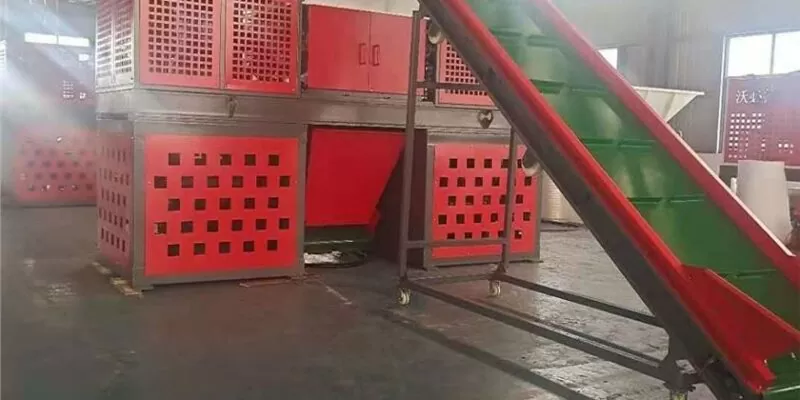
Which Machine Grinds Plastic?
| Machine | Typical feed | Typical output role |
|---|---|---|
| Single- or two-shaft shredder | Bulky parts, bales, lumps and difficult feed | Coarse pieces for handling or a second stage |
| Crusher or granulator | Bottles, sprues, profiles, sheets and prepared parts | Screen-controlled flakes or regrind |
| Pulverizer or mill | Clean, controlled flakes | Fine powder within a tested range |
| Wet crusher | Selected contaminated plastic entering a washing line | Flakes plus water-assisted conveying and initial rinsing |
Machine names vary between suppliers. Compare the actual cutting principle, speed, torque, screen, feed opening and proven output instead of relying on the label alone.
Shredder Versus Crusher or Granulator
A shredder normally operates at lower speed and higher torque. Its job is to grip and tear material that is too bulky or difficult for direct granulation. Output is often coarse and less uniform.
A crusher or granulator cuts with rotating and stationary knives. A screen retains material until it reaches the required flake range. It is the usual choice when the downstream washing, extrusion or molding step needs controlled regrind.
Review the AMIGE plastic shredder range and plastic crusher range as the two main size-reduction platforms.
When Is a Two-Stage System Better?
- Parts are too large for the crusher opening.
- Dense bales or lumps create unstable peak loads.
- The feed includes mixed shapes and thicknesses.
- The final flake must be smaller and more consistent than a shredder can provide.
- Controlled feeding between stages improves line stability.
A two-stage system costs more and occupies more space, but it may reduce manual preparation and protect the high-speed crusher. The decision should be based on material testing and cost per saleable ton.
When Is a Pulverizer Required?
If the specification calls for powder instead of flakes, a downstream pulverizer or mill is normally required. It needs clean, controlled feed and may require cooling, classification and dust collection.
See our guide on how plastic is turned into powder. A crusher alone should not be quoted as a powder-production machine.
How Material Changes Equipment Selection
- Rigid bottles and housings: often suit a crusher when feed dimensions are controlled.
- Film and woven bags: need a rotor and feeding arrangement that limits wrapping.
- Thick lumps and purgings: may need pre-shredding and high peak torque.
- Fiber-filled plastics: increase knife, screen and chamber wear.
- Foam: has low bulk density and requires controlled feeding and dust management.
- Wet or dirty scrap: changes wear, corrosion, cleaning and discharge requirements.
Output Size, Capacity and Energy
Smaller output is not automatically better. A smaller screen increases retention time and may reduce capacity while raising heat, fines, wear and energy per ton. Output should match the next washing, conveying, drying, extrusion or molding step.
Compare capacity only with the same polymer, feed dimensions, bulk density, contamination, screen and operating condition. A no-load motor rating does not prove production output.
Safety and Line Integration
- Use guarded conveyors, hoppers and discharge points.
- Remove metal, stones and prohibited items upstream.
- Apply lockout/tagout before cleaning, knife or screen work.
- Control dust, noise, heat and static for the complete installation.
- Provide safe lifting and access for heavy wear parts.
- Coordinate feeding and discharge controls between machines.
Information Needed for a Grinding-Machine Proposal
Send the polymer, material photos or samples, maximum dimensions and thickness, contamination, moisture, bulk density, hourly capacity, target output, downstream process, operating hours, voltage and layout.
Use the AMIGE inquiry form to share these details. We can determine whether the project needs a shredder, crusher, two-stage system or another specialized process.
Frequently Asked Questions
What machine is used to grind plastic?
Use a shredder for bulky coarse reduction, a crusher or granulator for controlled flakes, and a pulverizer for fine powder.
Can a plastic shredder produce uniform regrind?
Usually not as consistently as a screen-controlled crusher or granulator. Some lines therefore use both stages.
Can I grind plastic with a household blender?
It is not an appropriate industrial method. Household equipment lacks guarding, load capacity, dust control and safe service design.
What is the difference between plastic flakes and powder?
Flakes are normally produced by a crusher or granulator. Powder requires finer milling and classification in a dedicated system.
What determines plastic grinding capacity?
Polymer, dimensions, bulk density, contamination, machine design, screen, feeding, output target and wear condition all affect throughput.