

If you are planning a recycling line, the useful question is not only “How long will the shredder last?” It is “How many productive years will it deliver before downtime, wear parts, and energy costs make replacement the better decision?”
A correctly selected and maintained industrial shredder can typically serve for 10–20 years. That range is the machine’s service life, not the life of every component. Blades, bearings, seals, screens, motors, and gearboxes wear at different rates. Material, contamination, operating hours, loading, cooling, and maintenance determine where your machine lands within that range.
I’m Jacky, CEO of AMIGE. My practical advice is simple: do not buy a shredder by motor power alone. Match the cutter, shaft, drive, chamber, controls, and wear-part plan to your real feedstock and duty cycle. That is how you protect both lifespan and cost per processed ton.
What determines an industrial shredder’s lifespan?
| Factor | Why it affects service life | What a buyer should confirm |
|---|---|---|
| Feed material | Abrasive, reinforced, thick, or contaminated material increases blade and chamber wear. | Material type, bulk density, contaminants, maximum piece size, and moisture. |
| Daily duty cycle | Continuous operation creates more heat and leaves less time for inspection and cooling. | Operating hours per day, peak load, starts and stops, and planned downtime. |
| Required capacity | An undersized machine spends more time near overload and shortens component life. | Target kg/h, acceptable output size, and future capacity growth. |
| Feeding method | Uneven feeding, bridging, and impact loads stress shafts, bearings, and the drive. | Conveyor, hydraulic pusher, grab feeding, or manual feeding requirements. |
| Protection system | Automatic reverse, overload protection, and metal detection can prevent major damage. | PLC logic, current monitoring, emergency stops, and upstream separation. |
| Maintenance and parts | Late lubrication, loose fasteners, dull blades, and delayed parts replacement turn small problems into failures. | Maintenance schedule, local service ability, parts lead time, and recommended stock. |
How does material change shredder life expectancy?
Soft film, woven bags, rigid plastic lumps, pipes, textiles, wood, rubber, and metal drums do not create the same load. A shredder that performs well on LDPE film may be the wrong configuration for thick HDPE lumps or metal-contaminated scrap.
For plastic recycling, contamination often matters as much as the plastic itself. Sand, glass, stones, bolts, and unplanned metal pieces accelerate wear. If your input changes by season or supplier, design for the worst realistic feed—not the cleanest sample.
This is also why a quoted metal shredder life expectancy or plastic shredder lifespan cannot be copied from another plant. The useful comparison is service life under the same material, throughput, output size, and hours per day.
How long do the motor, gearbox, blades, and bearings last?
There is no responsible fixed number without operating data. A shredder motor’s life expectancy depends on loading, cooling, dust, voltage stability, starts per hour, alignment, and overload events. The gearbox also depends on correct lubrication, shaft alignment, shock loads, and temperature.
Blades are wear parts. Their usable interval changes sharply with cutter material, hardness, geometry, feed contamination, output size, and whether the blades can be rotated, sharpened, or rebuilt. Bearings and seals are strongly affected by dust, moisture, heat, and lubrication discipline.
Ask the supplier to separate the expected life of the machine frame from the expected maintenance cycle of wear parts. That gives you a much more realistic operating budget.
What maintenance extends an industrial shredder’s service life?
- Check blade condition, fasteners, clearances, and abnormal vibration before they damage the shaft or chamber.
- Follow the specified lubrication type and interval for bearings and gearbox components.
- Keep motors, cooling paths, electrical cabinets, and sensors free of dust and blocked airflow.
- Track motor current, temperature, vibration, throughput, and unplanned stops so deterioration is visible early.
- Do not compensate for dull blades or blocked discharge by continuously increasing feed pressure.
- Keep critical wear parts in stock according to actual lead time and production risk.
For more procurement checks, see our guide to plastic shredder after-sales support and spare-parts planning.
When should you repair, rebuild, or replace the shredder?
Repair is usually sensible when wear is localized and the frame, shafts, controls, and drive remain suitable for your capacity. A rebuild may make sense when the structure is sound but blades, bearings, seals, motor, gearbox, or controls need coordinated replacement.
Replacement becomes more attractive when failures repeat, parts are difficult to source, throughput no longer meets demand, energy per ton keeps rising, safety protection is outdated, or the machine cannot process your current material consistently.
Do not compare only the repair invoice with the purchase price. Compare total cost per saleable ton: downtime, labor, power, rejected output, spare parts, lost orders, and the capacity you cannot use.
What should you specify before buying a long-life shredder?
- Material type and clear photos or video.
- Maximum feed dimensions, wall thickness, and bulk density.
- Required capacity in kg/h and operating hours per day.
- Target output size and the next process in the recycling line.
- Contaminants or unplanned hard objects that may enter the chamber.
- Available voltage, frequency, installation space, and feeding method.
- Expected capacity growth and local maintenance capability.
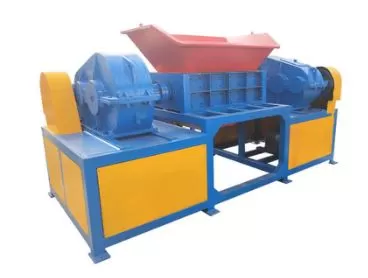
You can also compare our plastic shredder machine solutions and a two-shaft shredder for large plastic lumps.
Get a shredder configuration and lifecycle plan
Planning a new shredder or deciding whether to replace an old one? Send AMIGE your material, maximum piece size, required kg/h, and operating hours per day. We will use those facts to recommend the shaft layout, cutter material, motor and gearbox, overload protection, and wear-parts plan.
Frequently asked questions
What is the typical industrial shredder lifespan?
A correctly selected and maintained industrial shredder can typically serve for 10–20 years. Duty cycle, material, contamination, maintenance quality, and component selection determine the actual result.
What is a heavy-duty shredder motor’s life expectancy?
There is no universal number. Motor loading, cooling, dust, voltage stability, starts and stops, alignment, and overload history matter more than the “heavy-duty” label. Ask the supplier to size the drive from real operating data.
Does continuous operation shorten a shredding machine’s lifespan?
It can if the machine is undersized or lacks cooling and planned inspection time. A continuous-duty shredder should be configured for the required load, temperature, feed consistency, and maintenance windows.
Which parts usually wear out first?
Blades, screens, seals, bearings, and other material-contact parts usually need attention before the main frame. The exact order depends on feedstock, contaminants, output size, and operating practices.
What information is needed for an accurate shredder recommendation?
Provide material photos, maximum feed size, target kg/h, operating hours per day, desired output size, contaminants, voltage, feeding method, and the next process in your recycling line.
Conclusion
An industrial shredder is a long-term production asset, but service life is designed and managed—it is not guaranteed by a large motor or a heavy frame. Match the machine to your material and duty cycle, monitor the condition of wear parts, and compare repair or replacement by total cost per saleable ton.
