
Plastic recycling plants look busy on the surface.
But inside the shredder chamber, many lines are quietly bleeding efficiency.
Poor throughput.
Unstable particle size.
Frequent blade wear.
High power consumption.
I have seen these problems for more than 20 years.
In most cases, the root cause is not the motor, not the gearbox, not even the material.
It is the relationship between the dynamic blade and the fixed blade.
The short answer is simple.
Shredding efficiency is decided by how dynamic knives and fixed knives cooperate, not by knife quantity alone.
Only when blade angle, overlap, clearance, and sequence are designed as a system can cutting force replace tearing force, energy loss drop, and output stabilize.
If you think knife arrangement is just a mechanical detail, keep reading.
This detail decides whether your shredder works hard or works smart.
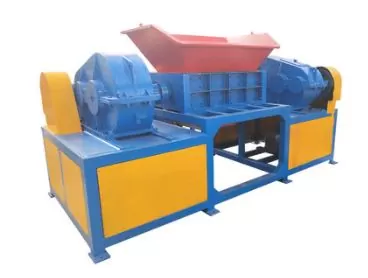
What Exactly Are Dynamic Blades and Fixed Blades?
In every industrial shredder, roles are clearly divided.
Dynamic blades move.
Fixed blades wait.
Dynamic blades are mounted on the rotating shaft.
They generate shear force through rotation.
Fixed blades are bolted to the chamber wall or knife holder.
They provide resistance and positioning.
Cutting only happens when these two meet.
Miss the timing or geometry, and cutting turns into tearing.
From our internal tests at Amige, improper blade pairing can reduce effective cutting efficiency by over 30% .
That loss does not show on a specification sheet.
It shows on your electricity bill.
Why Knife Arrangement Matters More Than Knife Material?
Many buyers ask me about blade steel first.
SKD-11 or D2?
Imported or local?
Steel matters.
But arrangement matters more.
Knife material determines durability.
Knife arrangement determines performance.
A perfect blade steel in a bad layout still produces:
– Uneven flakes
– Excessive dust
– Heat accumulation
According to industry benchmarking data, optimized knife geometry can improve throughput by 18–25% under the same motor power .
That is why old factories often outperform new ones.
They respect fundamentals. Two Shaft Shredder For Big Plastic Lump
How Does Knife Overlap Influence Shearing Force?
Overlap is the silent killer.
Too small, and material slips.
Too large, and blades collide.
Knife overlap refers to how much the dynamic blade crosses into the cutting zone of the fixed blade.
This overlap determines whether material is sliced or crushed.
Our standard design philosophy is conservative.
Controlled overlap.
Predictable wear.
Stable cutting.
Field data from long-term operation shows that optimal overlap reduces peak torque spikes by up to 22% .
Torque spikes destroy gearboxes.
I have replaced enough of them to be humble.
What Is the Ideal Clearance Between Dynamic and Fixed Blades?
Clearance is measured in millimeters.
Consequences are measured in years.
Too tight, and blades chip.
Too loose, and cutting becomes rubbing.
For rigid plastics like ABS and PS, we typically design tighter clearance.
For films and soft materials, clearance must breathe.
General industry guidance suggests clearance should stay within 0.2–0.5 mm depending on material hardness .
But I never trust a number without context.
Machines live in the real world.
Dust.
Heat.
Operator habits.
Design must forgive reality. Two shaft shredder for plastic lumps recycling
Does Blade Angle Really Change Energy Consumption?
Yes.
More than most people expect.
Blade angle controls entry resistance.
Sharp angle equals aggressive bite.
Blunt angle equals compression.
In shredding, compression wastes energy.
Shearing saves it.
Independent testing shows optimized blade angles can reduce energy consumption per ton by 12–18% .
This is not theory.
This is physics.
At Amige, we rarely chase extreme angles.
Balance always wins.
How Does Knife Sequence Affect Material Flow?
Knife sequence decides rhythm.
Good rhythm feeds itself.
Bad rhythm chokes.
Staggered knife arrangement allows progressive cutting.
Straight alignment invites material stacking.
In thick-wall products, progressive engagement prevents sudden overload.
In thin materials, it prevents wrapping.
Production data indicates staggered knife layouts improve feeding stability by over 20% in mixed material streams .
That difference is the line between automation and babysitting. Double Single Shaft Shredder For PP Woven Bag
Single-Shaft vs Dual-Shaft: Does Knife Logic Change?
Absolutely.
Single-shaft shredders rely heavily on fixed blades.
They demand precision.
Knife interaction must be exact.
Dual-shaft shredders rely on mutual pulling.
Dynamic blades work against each other.
Fixed blades play a supporting role.
Confusing these two logics leads to expensive mistakes.
I have seen dual-shaft machines retrofitted with single-shaft blade philosophy.
They fail quietly.
Then suddenly.
According to market failure analysis, mismatched blade logic accounts for 15% of early shredder performance complaints .
Old lessons repeat themselves.
How Do You Balance Cutting Efficiency and Blade Life?
This is where experience speaks.
Not catalogs.
Maximum sharpness shortens life.
Maximum life dulls performance.
Our internal rule is simple.
Design for stable dullness.
Blades should degrade slowly and predictably.
Not dramatically.
Lifecycle analysis shows that moderate blade geometry extends service intervals by up to 35% without sacrificing output .
Machines are assets.
Not experiments. Two single shaft shredder for woven bag shredding
What Mistakes Do Buyers Commonly Make?
They count blades.
They ignore layout.
They ask for harder steel.
They forget clearance.
They chase low price.
They pay later.
From my seat as CEO, the most expensive shredder is the one that looks good on paper but fights physics every day.
Tradition exists for a reason.
We did not invent these rules.
We inherited them.
Conclusion
Dynamic blades and fixed blades are not rivals.
They are partners.
When arranged with respect for physics, materials, and experience, shredders cut cleaner, last longer, and consume less.
In recycling, details decide margins.