

A double-shaft shredder reduces bulky or difficult waste by pulling it between two slow-turning cutter shafts. The cutters grip, shear, tear and compress the material instead of relying on high-speed impact. This makes the machine useful for primary size reduction where feed control and high torque matter more than a fine, uniform final particle.
The two shafts rotate toward the cutting chamber, and intermeshing cutters draw material into the gap. A geared drive supplies torque; spacers and cleaning elements manage the cut; and the control system can stop or reverse the shafts when load rises. The exact action depends on cutter geometry, shaft speed, drive and material.
I’m Jacky, CEO of AMIGE. Buyers often ask first for motor power. I prefer to begin with the waste: its maximum size, wall thickness, shape, bulk density, contamination and the output needed by the next machine.
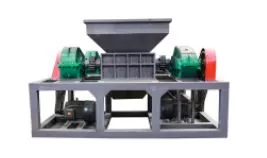
How a double-shaft shredder works step by step
1. Material enters the hopper
Waste enters by conveyor, loader, grab or manual feeding, depending on the installation. Hopper size and shape must prevent bridging while keeping operators away from the cutting chamber. The infeed system should meter material so the machine is not repeatedly shock-loaded.
2. Counter-rotating cutters grip the waste
Each shaft carries cutters separated by spacers. As the shafts turn, the cutter hooks engage the feed and pull it downward. Hook profile, cutter thickness, clearance and shaft spacing influence how well the machine grabs film, drums, lumps, appliances or other material.
3. Torque shears and tears the material
The drive and gearbox convert motor power into low-speed torque at the shafts. Material is sheared between cutter edges and torn as adjacent cutters pull it in different directions. Slow operation can reduce dust and noise compared with high-speed crushing, although actual performance depends on the waste and enclosure.
4. Controls react to overload
A programmable control system monitors load. When the preset threshold is reached, it can stop and reverse the shafts to release the jam, then resume forward operation. This protection helps manage variable feed but does not make the machine immune to unshreddable metal or improper loading.
5. Shredded pieces discharge for the next stage
Output falls by gravity or onto a conveyor. Some two-shaft designs control size mainly through cutter geometry and repeated biting rather than a screen. If the process needs smaller, more uniform flakes, the material may pass through a magnet or metal separator and then a plastic crusher or granulator.
What determines shredder output and capacity?
| Variable | Why it matters |
|---|---|
| Material form | Film, pipe, lumps, drums and textiles grip and cut differently. |
| Maximum dimensions | Large or nested items affect hopper, chamber and feeding design. |
| Wall thickness and toughness | These influence torque, cutter profile and number of cutting passes. |
| Bulk density | Volume can limit feeding before motor power becomes the bottleneck. |
| Cutter thickness | Helps define the nominal cut but does not guarantee final uniformity. |
| Hook geometry | Controls bite, pull-in behavior and resistance to wrapping. |
| Shaft speed | Affects throughput, heat, noise, wear and reaction to contamination. |
| Downstream requirement | Washing, sorting or granulation may require a different discharge size. |
A supplier should state capacity together with the tested material, feed condition, operating time and output requirement. A single maximum kg/h number without those conditions is not a dependable production guarantee.
When should you choose a double-shaft shredder?
A twin-shaft machine is commonly considered for bulky plastics, drums, thick parts, mixed industrial waste, appliances, textiles, wood or metal-bearing streams when configured for the application. It is especially useful when the first goal is volume reduction or opening material for sorting and secondary processing.
It may not be the best choice when the main requirement is a tightly controlled small flake in one pass. A single-shaft shredder with a screen or a high-speed granulator can provide more controlled sizing for suitable plastic feed. For some lines, the correct answer is a two-stage system: shred first, then granulate.
Double-shaft vs single-shaft shredder
| Area | Double shaft | Single shaft |
|---|---|---|
| Cutting action | Two counter-rotating cutter shafts | One rotor working against fixed knives |
| Feeding | Self-gripping action for suitable bulky feed | Often uses a hydraulic pusher |
| Output control | Often coarse and cutter-dependent | Commonly controlled by a screen |
| Typical role | Primary reduction and material opening | Controlled shredding for specified output |
| Selection risk | Poor grip, wrapping or oversize output | Bridging, ram behavior or screen restriction |
What should buyers check before ordering?
- Representative material test with normal contamination.
- Measured throughput, test duration and output-size distribution.
- Cutter material, hardness, thickness, hook profile and rebuild method.
- Shaft, bearing, seal, gearbox and coupling arrangement.
- Automatic reversal logic and protection against overload.
- Access for cleaning, cutter replacement and safe lockout.
- Feed conveyor, discharge conveyor, magnet and dust-control scope.
- Critical spare parts, tools, documentation, training and warranty.
AMIGE supplies double-shaft shredder machines and integrated plastic size-reduction systems. We select the cutting chamber and supporting equipment from the actual feed and downstream process rather than treating every waste stream as identical.
Need a double-shaft shredder configuration? Send the material type, photos or video, maximum dimensions, hourly capacity, contamination, required output and next processing step. We can assess whether a two-shaft machine or another size-reduction layout is more suitable.
Frequently asked questions
Does a double-shaft shredder use a screen?
Many twin-shaft shredders rely mainly on cutter geometry rather than a sizing screen, but designs vary. Confirm how the quoted machine controls oversize and whether secondary granulation is required.
Can a double-shaft shredder process plastic film?
It can process suitable film and bags when cutter geometry, clearances and feeding are designed to control wrapping. A representative test is important.
Why does a double-shaft shredder reverse?
Automatic reversal can release overloaded material and protect the drive. Frequent reversals may indicate excessive feeding, foreign objects or an unsuitable cutter configuration.
What output size does a twin-shaft shredder produce?
Output depends on cutter thickness and shape, shaft arrangement, material behavior and repeated passes. Ask for an output distribution from a representative test, not one nominal number.
How do I choose a double-shaft shredder?
Define material, dimensions, wall thickness, bulk density, contamination, capacity, output and downstream process, then compare tested results, cutter design, maintenance and complete scope.
Conclusion
A double-shaft shredder works by gripping and shearing material between two slow, high-torque cutter shafts. Its value depends on application-specific cutter and system design, so demand test evidence and a complete production scope before buying.
