

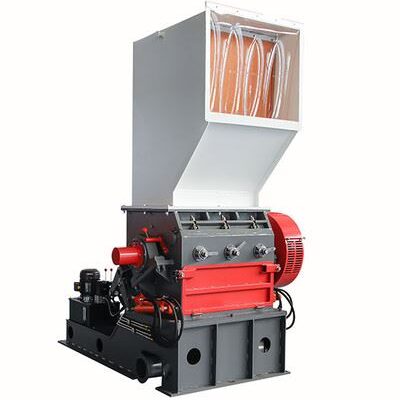
A plastic crusher machine reduces bottles, sprues, profiles, sheets, containers and other suitable plastic scrap into screen-controlled flakes or regrind. Rotating knives pass fixed knives inside the cutting chamber, and material leaves only after it is small enough to pass through the screen.
The correct crusher is defined by the feed and the next process—not by motor power alone. Polymer, largest dimensions, wall thickness, contamination, target flake, hourly input and operating hours all change the required rotor, knives, screen, hopper and drive.
I’m Jacky, CEO of AMIGE. When a buyer asks for a “standard plastic crusher,” my first question is simple: what is the most difficult piece the machine must process? That answer usually reveals more than a catalogue model number.
How does a plastic crusher machine work?
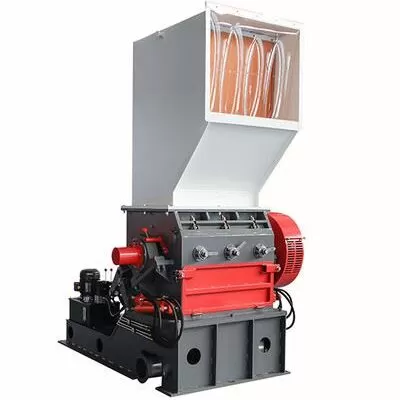
Material enters through a guarded hopper. The rotor carries moving knives past stationary bed knives, producing repeated shear cuts. Oversized pieces remain in the chamber until they can pass through the perforated screen. A bin, blower or conveyor then transfers the regrind to washing, blending, extrusion or storage.
Knife sharpness, knife clearance, rotor geometry and screen open area influence capacity, heat, fines and particle distribution. The detailed industrial plastic crusher working-principle guide explains these functions further.
Main plastic crusher components
| Component | Purpose | Buyer check |
|---|---|---|
| Hopper | Presents material to the chamber while limiting access and kickback | Largest feed size, loading method and anti-bridging design |
| Rotor and moving knives | Create the cutting action | Geometry, rigidity, knife material and replacement access |
| Fixed knives | Provide the opposing cutting edge | Adjustment method, clearance and fastening |
| Screen | Controls when material can discharge | Opening, open area, strength and changeover access |
| Drive | Supplies and transmits power | Motor, belts or coupling, overload response and local electrical supply |
| Discharge | Removes flakes from the machine | Dust, airflow, bin or conveyor capacity and downstream interface |
Which plastics can a crusher process?
Common applications include PET and HDPE bottles, PP crates, injection-molding sprues, PVC or PE profiles, sheets, prepared pipes, appliance housings and selected film. Suitability changes with size, shape, toughness, moisture, temperature, fillers and contamination.
Long pipes, bulky lumps, complete bales or elastic film may need a special hopper, force feeder or a shredder before the crusher. Metal, stones and unknown hazardous items require upstream control; they should never be treated as ordinary plastic feed.
Crusher, shredder, granulator or pulverizer?
- Plastic shredder: lower-speed, higher-torque coarse reduction for bulky or difficult feed.
- Plastic crusher or granulator: higher-speed knife cutting for screen-controlled flakes and regrind.
- Plastic pulverizer: fine milling of clean, prepared material into powder for a defined application.
- Two-stage line: shredding first and crushing second when one machine cannot safely achieve the required reduction ratio.
Suppliers do not always use these names consistently. Compare the cutting principle, speed, torque, screen and tested output instead of buying from the label alone.
What determines crusher capacity and flake quality?
- Polymer, feed shape, thickness and toughness
- Largest dimensions and bulk density
- Loose, nested, bundled or pre-cut condition
- Rotor width, knife arrangement and cutting clearance
- Screen opening and total open area
- Knife wear, contamination and material temperature
- Feeding consistency and discharge capacity
- Accepted flake range after fines and oversize are removed
A smaller screen does not automatically create a better production result. It may increase recirculation, heat, fines and energy per usable tonne. Capacity should be stated with the material, screen, feed method, test duration and acceptable output.
How should buyers compare plastic crusher quotations?
Send every supplier the same material and output specification. Compare the chamber, rotor, knives, screen, bearings, frame, drive, controls, guarding, discharge, cleaning access, spare parts and documentation on the same scope. Request a representative material test when capacity or flake quality is critical.
Review the AMIGE plastic crusher machine range to understand available configurations. Final selection should still follow your actual material and downstream process.
Safety, maintenance and lifetime cost
Plan guarded feeding, emergency stops, interlocks, overload protection and site lockout procedures. Maintenance access should allow safe inspection of knives, screen, fasteners, bearings and drive components. Dust, noise, heat and fire risk must be evaluated for the complete installation.
Purchase price is only one cost. Include knife sharpening, screen replacement, cleaning, planned downtime, energy, labor, spare inventory and rejected output when comparing machines.
Information AMIGE needs for a crusher proposal
Provide material photos or samples, polymer, maximum dimensions, wall thickness, piece weight, contamination, hourly input, operating hours, target flake range, downstream process, feeding method, voltage and factory layout. Include the hardest or largest expected item—not only the average feed.
Frequently asked questions
What is the main purpose of a plastic crusher machine?
It cuts suitable plastic scrap into controlled flakes or regrind so the material can be conveyed, washed, blended, extruded or reused more consistently.
Is a plastic crusher the same as a plastic shredder?
No. A shredder generally provides lower-speed, high-torque coarse reduction, while a crusher or granulator provides faster, screen-controlled cutting.
Can one crusher process both rigid plastic and film?
Only if its feeding and cutting system is designed and tested for both. Film can wrap or bridge, while thick rigid scrap creates different impact and torque loads.
How is the output size of a plastic crusher controlled?
The screen opening is important, but rotor geometry, knife clearance, wear and material behavior also affect the complete particle-size distribution.
What information is required for a plastic crusher quotation?
Send material, dimensions, contamination, input per hour, operating schedule, target flake, downstream process, feed method, utilities and layout.
