

Buying a new plastic shredder is easy to justify when the old machine finally stops. The harder decision comes when the old machine still runs—but consumes too much electricity, requires frequent maintenance, creates excessive downtime, and limits production capacity. Many recycling companies continue using inefficient equipment simply because it has already been paid for. From my experience at AMIGE, that can be an expensive mistake. The right question is not, “How much does a new shredder cost?” The better question is, “How quickly can a high-performance shredder generate enough additional profit to pay for itself?”
A high-performance plastic shredder can potentially recover its investment within roughly 12–36 months when it delivers measurable improvements in throughput, energy consumption per ton, labor efficiency, maintenance cost, downtime, and material recovery. However, there is no universal payback period. At AMIGE, I prefer calculating ROI from the customer’s real production data. A shredder should not be judged by its purchase price alone. It should be judged by how much additional profit it can create during its working life.
A cheap shredder saves money once.
An efficient shredder can save money every working day.
That difference becomes very interesting after 3,000 operating hours.
Why Should Recycling Companies Calculate Shredder ROI Before Buying?
When customers ask me for a quotation, machine price is naturally one of their first questions.
I understand.
Capital expenditure matters.
But purchase price is only one part of the total cost of ownership.
A recycling company actually pays for its shredder through several channels:
- Initial machine investment
- Electricity consumption
- Labor
- Blades and wear parts
- Lubrication
- Maintenance
- Unplanned downtime
- Lost production
- Material losses
This is why two machines with similar purchase prices can produce completely different financial results after five years.
The invoice tells you what the machine costs today.
ROI tells you what the machine may be worth tomorrow.
What Is the Basic Formula for Shredder ROI?
I normally start with a very simple calculation.
Annual ROI (%) = Annual Net Financial Benefit ÷ Total Investment × 100
For example, assume a recycling company invests US$80,000 in a new shredding system.
After installation, the machine generates:
- US$18,000/year electricity savings
- US$12,000/year maintenance savings
- US$10,000/year labor savings
- US$35,000/year additional gross profit from higher production
Total annual benefit:
US$75,000
If we temporarily ignore financing, tax, depreciation, and other project-specific costs:
ROI = US$75,000 ÷ US$80,000 × 100 = 93.75%
Simple payback:
US$80,000 ÷ US$75,000 = approximately 1.07 years
That is around 13 months.
Of course, this is only an illustrative example.
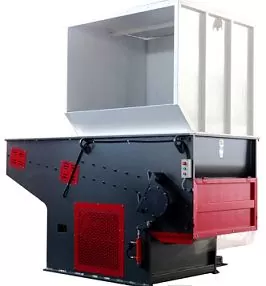
Real projects should use actual electricity tariffs, working hours, labor costs, maintenance records, material margins, and production data. Single Shaft Shredder Machine For LDPE Film
Where Does the Financial Return Actually Come From?
This is where ROI calculations become useful.
A better shredder does not create returns from one source.
It creates several smaller improvements that accumulate.
1. Electricity Savings
Electricity consumption should be measured in kWh per ton, not simply by comparing motor nameplate power.
Suppose:
Old shredder: 85 kWh/ton
New shredder: 65 kWh/ton
Difference:
20 kWh/ton
At 3,000 tons per year:
20 × 3,000 = 60,000 kWh saved annually
Multiply this figure by the customer’s electricity price.
Now energy efficiency becomes money.
The Industrial Energy Efficiency Benchmark provides additional reference information for comparing industrial size-reduction energy consumption.
2. Maintenance Savings
Old equipment often requires:
- Frequent bearing replacement
- Gearbox maintenance
- Blade changes
- Hydraulic repairs
- Emergency service
One repair may look small.
Twenty repairs do not.
3. Reduced Downtime
This is one of the most underestimated costs in recycling.
When the shredder stops, downstream equipment may also stop.
The real cost therefore includes lost production.
How Much Money Can Higher Throughput Generate?
Now we reach the interesting part.
Suppose an old shredder processes:
700 kg/hour
A new high-performance shredder processes:
1,000 kg/hour
The improvement is:
300 kg/hour
If the factory operates 10 hours per day for 300 days:
300 kg × 10 × 300 = 900,000 kg
That equals:
900 additional tons per year
Now assume the recycler generates only US$60 of contribution margin from each additional processed ton.
Potential additional annual contribution:
900 × US$60 = US$54,000
Suddenly, the machine price looks different.
This is why I repeatedly tell customers:
Do not compare only motor kilowatts.
Compare profitable tons per year.
Why Is Downtime One of the Biggest Hidden ROI Factors?
Imagine a recycling plant processes 1 ton per hour.
Its shredder experiences approximately 20 hours of avoidable downtime every month.
That equals:
240 hours per year.
At 1 ton/hour:
240 tons of potential production are lost.
If contribution margin is US$100 per processed ton, that represents:
US$24,000 of potential contribution annually.
And we have not included overtime, delayed orders, technician costs, or downstream idle time.
The Recycling Equipment Downtime Cost Study illustrates why equipment availability should be incorporated into investment calculations.
A machine that is stopped consumes very little electricity.
Unfortunately, it also produces very little revenue.
How Does Blade Design Influence ROI?
Blades are relatively small compared with the entire shredder.
Financially, however, they matter enormously.
Good blade geometry can influence:
- Cutting efficiency
- Motor load
- Output consistency
- Blade lifetime
- Production capacity
Material selection also matters.
Depending on the application, we may evaluate wear-resistant tool steels such as D2 or DC53 and match the blade configuration to the customer’s material.
But I never recommend selecting blade material by hardness alone.
A knife that is extremely hard but unsuitable for the application can become brittle.
Engineering requires balance.
The correct blade should achieve an economical combination of:
wear resistance + toughness + cutting performance + maintenance cost.
Can Automation Improve the Payback Period?
Absolutely.
Modern shredders can integrate:
- PLC control
- Automatic reverse
- Hydraulic pusher control
- Overload protection
- Current monitoring
- Alarm systems
- Remote diagnostics
These features reduce operator intervention.
More importantly, they stabilize production.
Suppose an operator must stop an older machine repeatedly because of overloads.
With intelligent automatic reverse control, the shredder may recover from temporary overload conditions without manual intervention.
One automatic reverse may save only several minutes.
Multiply those minutes by hundreds of events every year.
That is where automation begins producing financial value.
What Would a Practical ROI Example Look Like?
Let us build a more complete example.
Assume a recycling company is considering replacing an older shredder.
New Equipment Investment
Machine + auxiliary equipment + installation:
US$100,000
Annual Benefits
Energy savings: US$15,000
Maintenance savings: US$10,000
Labor savings: US$8,000
Reduced downtime benefit: US$17,000
Additional contribution from increased capacity: US$40,000
Total Annual Benefit
US$90,000
Now subtract US$10,000 in estimated additional annual costs associated with the new investment.
Net annual benefit:
US$80,000
Simple payback:
US$100,000 ÷ US$80,000 = 1.25 years
Approximately:
15 months
That is a much more useful purchasing calculation than simply saying:
“Machine A costs US$10,000 less.”
What Happens If the New Machine Is More Expensive?
This is another common purchasing dilemma.
Suppose:
Machine A costs US$70,000.
Machine B costs US$90,000.
Many buyers immediately prefer Machine A.
But imagine Machine B saves an additional US$12,000 annually in electricity and US$8,000 in maintenance.
Additional investment:
US$20,000
Additional annual savings:
US$20,000
The extra investment pays back in approximately one year.
After that, the efficiency advantage continues.
The Lifecycle Equipment Cost Model demonstrates why industrial equipment should be evaluated across its operating life rather than solely through acquisition price.
Purchase price is visible.
Operating cost is quieter.
But operating cost keeps sending invoices.
Which Materials Can Produce Different ROI Results?
ROI depends heavily on application.
For example:
LDPE Film and PP Woven Bags
Important factors include:
- Material feeding
- Anti-wrapping design
- Stable rotor load
- Continuous production
HDPE Drums and Containers
Important factors include:
- Feeding opening
- Torque
- Blade strength
- Cutting chamber structure
Plastic Pallets
Important factors include:
- Rotor width
- Throughput
- Wear resistance
Pipes and Thick Plastic Blocks
Important factors include:
- Hydraulic pushing force
- Rotor strength
- Motor configuration
- Cutting efficiency
This is why AMIGE does not calculate ROI from machine model alone.
We calculate it from material + capacity + working hours + operating cost + output value.
When Should You Replace an Existing Shredder?
An old machine does not need to be completely broken before replacement makes financial sense.
I would investigate replacement when:
- Electricity consumption per ton keeps increasing.
- Maintenance frequency rises.
- Production capacity cannot meet demand.
- Machine jams become frequent.
- Spare parts become difficult to source.
- Labor requirements are excessive.
- Downstream equipment waits for material.
- Product quality becomes inconsistent.
At that point, keeping the old machine may actually require more money than replacing it.
The correct comparison is therefore:
Cost of keeping the old machine vs. return from installing the new machine.
What Information Should You Give a Shredder Manufacturer Before Requesting an ROI Analysis?
For a meaningful calculation, I recommend preparing:
- Material name
- Material photos/videos
- Maximum feeding dimensions
- Bulk density
- Current throughput
- Required throughput
- Daily operating hours
- Annual working days
- Current motor power
- Actual electricity consumption
- Electricity tariff
- Current maintenance cost
- Labor requirement
- Required discharge size
- Value or margin per ton
The better the input data, the better the ROI estimate.
I would rather give a customer a conservative calculation based on real information than an impressive number based on imagination.
Why Do I Prefer Payback Period Plus Total Cost of Ownership?
ROI is useful.
But it should not stand alone.
For industrial equipment, I recommend evaluating three figures together:
1. Initial Investment
How much capital is required?
2. Payback Period
How long before accumulated benefits recover the investment?
3. Five-Year Total Cost of Ownership
How much will the machine cost to own and operate?
This creates a much more realistic comparison between suppliers.
A machine is purchased once.
But it is operated thousands of times.
How Does AMIGE Approach ROI-Based Equipment Selection?
At AMIGE, we prefer to start with the customer’s production problem.
Not our catalog.
We evaluate:
- What material are you processing?
- What is limiting your current capacity?
- Where is energy being wasted?
- How much downtime are you experiencing?
- What output do you need?
- What happens downstream after shredding?
Then we select the appropriate solution.
Depending on the material, that could mean:
- Single-shaft shredder
- Double-shaft shredder
- Shredder + crusher combination
- Complete washing line
- Integrated recycling system
Our objective is not simply to increase installed horsepower.
Our objective is to improve economic output per operating hour.
That is a much better KPI.
Is a High-Performance Shredder Always Worth the Investment?
No.
And I think a professional manufacturer should be willing to say that.
If your existing machine already has:
- Low energy consumption
- Stable production
- Sufficient capacity
- Low maintenance cost
- High availability
then replacing it purely because a newer model exists may not produce attractive ROI.
But if your existing equipment is limiting production, consuming excessive electricity, creating downtime, or increasing labor costs, an upgrade deserves serious financial analysis.
Machines should solve business problems.
Not create new depreciation schedules for decoration.
Conclusion
A high-performance shredder can potentially pay for itself through energy savings, higher throughput, lower maintenance, reduced downtime, and better labor efficiency. The correct payback period depends on real operating data. At AMIGE, we believe the best shredder investment is not the cheapest machine—it is the machine that creates the strongest long-term return.
s
#PlasticShredder
#ShredderROI
#PlasticRecycling
#IndustrialShredder
#RecyclingEquipment
#EnergyEfficientShredder
#PlasticRecyclingMachine
#RecyclingInvestment
#WasteRecycling
