

Plastic pollution has become a global business and environmental challenge. Governments are tightening packaging rules. Brands are setting recycled-content targets. Consumers increasingly expect sustainable products. Meanwhile, recycling companies face rising electricity costs, unstable feedstock quality, labor shortages, and tougher requirements for recycled materials. The pressure is obvious. But so is the opportunity. From my perspective at AMIGE, global plastic reduction does not mean the world will simply “use less plastic.” It means we must use plastic more intelligently, recover more of it, and build recycling systems capable of turning yesterday’s waste into tomorrow’s raw material.
Global plastic reduction initiatives are creating major opportunities for the waste plastic recycling industry. Demand for recycled PE, PP, PET, HDPE, and other polymers is expanding as manufacturers seek more circular supply chains. At the same time, recyclers must overcome contamination, inconsistent waste streams, energy costs, automation requirements, and stricter quality standards. The companies that combine reliable recycling equipment, intelligent automation, energy efficiency, and strong material-management capabilities will be better positioned to benefit from this transition.
Plastic reduction is not the end of the plastics industry.
It is the beginning of a more sophisticated plastics industry.
And recycling sits directly in the middle of that transformation.
Why Is Global Plastic Reduction Accelerating?
For decades, the global plastics economy largely followed a linear model:
Produce.
Consume.
Discard.
That model is increasingly difficult to sustain.
Governments, brands, manufacturers, and consumers are paying greater attention to plastic waste, resource efficiency, carbon emissions, and recycling performance.
According to the Global Plastics Circularity Outlook, policies supporting waste reduction, recycling, reusable packaging, and recycled-content utilization are becoming increasingly important across major markets.
For recycling companies, this creates a fundamental change.
Waste plastic is becoming a strategic raw material.
Does Plastic Reduction Mean Less Business for Plastic Recyclers?
This is a question I hear surprisingly often.
My answer is usually no.
Plastic reduction primarily targets unnecessary consumption, difficult-to-recycle products, excessive packaging, and inefficient waste management.
At the same time, industries still require plastics for:
- Food packaging
- Automotive components
- Construction
- Medical products
- Agriculture
- Electronics
- Logistics
- Consumer goods
The challenge is therefore not eliminating every kilogram of plastic.
It is keeping valuable polymers circulating for longer.
That creates significant opportunities for professional recyclers.
Why Will Recycled Plastic Demand Continue to Create Opportunities?
More manufacturers are evaluating recycled materials as part of their raw-material strategies.
This increases demand for:
- Recycled HDPE
- Recycled LDPE
- Recycled PP
- Recycled PET
- Recycled ABS
- Other secondary polymers
But there is an important condition.
Customers do not simply want “recycled plastic.”
They want recycled plastic with predictable:
- Purity
- Color
- Moisture
- Particle size
- Melt characteristics
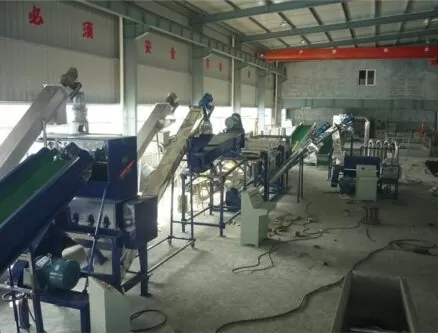
- Contamination levels Rigid PE/PP Plastic Container Crushing & Washing Recycling Line
According to the Recycled Polymer Market Development Report, quality consistency is becoming increasingly important as recycled materials move into higher-value applications.
This is good news for technically capable recycling companies.
Quality creates differentiation.
Why Is Better Recycling Equipment Becoming More Important?
When recycled plastic requirements increase, recycling machinery must improve too.
A traditional recycling plant might accept:
High energy consumption.
Frequent machine jams.
Inconsistent output.
Manual material handling.
That is becoming increasingly difficult.
Modern plants require equipment capable of delivering:
- Stable throughput
- Controlled particle size
- Lower energy consumption
- Better contamination removal
- Automated operation
- Consistent final quality
At AMIGE, this is why we increasingly discuss the entire process with customers rather than simply selling an individual machine.
A shredder does not work alone.
Neither does a recycling business.
What Role Do Shredders Play in Global Plastic Reduction?
Shredding is often the first major mechanical processing stage.
Large plastic products must be converted into manageable sizes before efficient sorting, washing, crushing, or pelletizing.
Typical materials include:
- Plastic pallets
- HDPE drums
- PP woven bags
- LDPE film
- Agricultural film
- Plastic pipes
- Automotive plastics
- Injection molding waste
- Industrial plastic blocks
An efficient shredder improves material preparation.
That can improve the entire downstream process.
The Industrial Plastic Size Redustion Study highlights particle-size control and stable feeding as important factors affecting downstream recycling efficiency.
Good recycling begins with good preparation.
Why Are Washing Lines Becoming More Sophisticated?
Collecting plastic is relatively easy.
Producing high-quality recycled material is much harder.
Post-consumer plastics may contain:
- Sand
- Soil
- Labels
- Adhesives
- Food residues
- Oil
- Paper
- Metals
Modern washing lines therefore combine multiple technologies.
Depending on the application, these may include:
- Pre-washing
- Friction washing
- Floating separation
- Hot washing
- Mechanical dewatering
- Thermal drying
Better washing improves recycled material value.
And material value ultimately determines recycling profitability.
Why Is Energy Efficiency Becoming a Competitive Advantage?
Recycling is environmentally valuable.
But recycling equipment still consumes electricity.
This creates an interesting challenge.
A recycling factory cannot claim efficiency while wasting energy throughout production.
Modern recycling equipment therefore increasingly focuses on:
- Efficient motors
- Optimized rotor structures
- Intelligent feeding
- Variable-frequency control
- Reduced idle running
- Energy monitoring
I encourage customers to calculate electricity consumption as:
kWh per ton of processed material.
This is much more meaningful than simply looking at motor power.
The Recycling Energy Efficiency Benchmark provides reference data for evaluating industrial recycling energy performance.
Every unnecessary kilowatt-hour reduces margin.
How Is Automation Changing Plastic Recycling?
Labor costs are rising in many markets.
Experienced operators are also becoming harder to recruit.
Automation helps recycling plants reduce dependence on manual intervention.
Modern systems can integrate:
- Automatic conveyors
- Hydraulic feeding
- PLC control
- Automatic overload reverse
- Metal detection
- Material level monitoring
- Centralized control
- Remote diagnostics
Automation does not mean removing people.
It means allowing people to manage production instead of constantly fighting machines.
Will AI Become Important in Plastic Recycling?
Yes.
But we should remain practical.
AI will not magically turn contaminated waste into premium pellets overnight.
It can, however, improve several important areas.
These include:
Intelligent Sorting
Vision systems can help identify different materials.
Predictive Maintenance
Equipment data can identify abnormal operating conditions.
Energy Optimization
Production parameters can be adjusted according to machine load.
Quality Monitoring
Digital systems can track production consistency.
The Smart Recycling Technology Outlook identifies AI-assisted sorting and predictive monitoring as promising directions for recycling automation.
The future is intelligent.
But good mechanical engineering still matters.
A clever algorithm cannot repair a badly designed rotor.
What Is the Biggest Challenge Facing Waste Plastic Recyclers?
In my experience, one word explains many problems:
Contamination.
Recycling companies rarely receive perfectly clean material.
Real-world waste may contain:
- Different polymers
- Metal
- Sand
- Wood
- Paper
- Organic contamination
- Moisture
This affects:
- Machine wear
- Washing cost
- Energy consumption
- Final material quality
- Selling price
The challenge is therefore not simply processing more tons.
It is recovering more valuable material from every ton.
Why Is Feedstock Supply Another Major Challenge?
A recycling factory requires stable material supply.
Without enough feedstock, even excellent equipment sits idle.
Recyclers therefore need reliable collection networks.
Potential sources include:
- Municipal waste systems
- Factories
- Packaging companies
- Agricultural operations
- Logistics centers
- Automotive dismantlers
- Plastic processors
Successful recycling businesses increasingly manage both sides of the equation:
Where does the waste come from?
Who will buy the recycled material?
Machines operate in the middle.
The business model surrounds them.
How Are Regulations Creating Both Pressure and Opportunity?
Environmental regulations can increase compliance costs.
But they can also create demand.
Requirements involving:
- Recycled content
- Packaging recyclability
- Waste collection
- Producer responsibility
- Traceability
- Machinery safety
can encourage investment in professional recycling infrastructure.
The International Circular Plastics Policy Monitor tracks the growing influence of recycling and circularity policies across international markets.
For equipment manufacturers like us, this means customers increasingly ask more sophisticated questions.
Not only:
“How many kilograms per hour?”
But also:
“How efficiently can I produce a marketable recycled material?”
That is progress.
Where Are the Biggest Opportunities for Recycling Companies?
I see several promising directions.
Flexible Plastic Recycling
LDPE film, agricultural film, and PP woven bags remain challenging but valuable waste streams.
Rigid Plastic Recycling
HDPE bottles, drums, pallets, crates, and PP products provide strong mechanical recycling opportunities.
Automotive Plastic Recycling
Bumpers, dashboards, and interior components represent an increasingly important resource stream.
Industrial Scrap Recycling
Clean factory waste can often be recovered economically with relatively simple processing.
Marine Plastic and Fishing Net Recycling
Coastal cleanup projects can combine environmental benefits with material recovery.
Different waste streams require different technologies.
There is no universal recycling line.
Why Will Complete Recycling Solutions Become More Popular?
Many customers previously purchased equipment separately.
One shredder here.
One crusher there.
One washing machine somewhere else.
The result could become an engineering puzzle.
Modern customers increasingly prefer integrated solutions.
A complete system may combine:
Feeding → Shredding → Crushing → Washing → Separation → Dewatering → Drying → Pelletizing
When equipment is designed as one system, customers can improve:
- Material flow
- Energy efficiency
- Automation
- Maintenance
- Production consistency
At AMIGE, this system-level approach is becoming increasingly important.
How Should Recycling Companies Prepare for the Next Five Years?
I recommend focusing on five areas.
First, understand your material deeply.
Second, measure real production costs.
Third, improve automation gradually.
Fourth, invest in reliable equipment rather than simply cheap equipment.
Fifth, build stable markets for recycled output.
Technology matters.
But technology must support a profitable business model.
The strongest recycling companies will combine:
material knowledge + efficient machinery + automation + quality control + market access.
That combination is difficult to copy.
What Is AMIGE’s Role in This Global Transition?
At AMIGE, we manufacture:
- Single-shaft shredders
- Double-shaft shredders
- Plastic crushers
- Washing lines
- Dewatering systems
- Pelletizing lines
But I see our role as broader than equipment manufacturing.
Our responsibility is to understand what customers are processing and recommend a practical solution.
We evaluate:
- Material
- Contamination
- Capacity
- Final product
- Energy requirements
- Factory layout
- Budget
Then we configure the recycling system.
The objective is not simply to make plastic smaller.
The objective is to make recycling more valuable.
Conclusion
Global plastic reduction is creating both pressure and opportunity for the recycling industry. Companies that improve material recovery, automation, energy efficiency, and recycled-product quality will be better positioned for growth. At AMIGE, we believe the future is not simply about using less plastic—it is about keeping valuable plastics circulating longer.
#PlasticRecycling
#PlasticReduction
#CircularEconomy
#PlasticShredder
#PlasticCrusher
#RecyclingEquipment
#WastePlasticRecycling
#SustainableManufacturing
#RecyclingTechnology
#AMIGE
