

Around the world, industries are searching for smarter ways to reduce landfill waste, lower fossil fuel consumption, and support carbon reduction goals. One solution gaining rapid momentum is the production of Solid Recovered Fuel (SRF) and Refuse Derived Fuel (RDF). Instead of sending combustible waste to landfills, recyclable and non-recyclable fractions can be converted into alternative fuels for cement plants, power stations, and industrial boilers. However, none of this happens without effective size reduction. As the CEO of AMIGE, I have learned that producing high-quality SRF/RDF starts long before the material enters a kiln. It begins with intelligent shredding.
Modern shredding technology plays a critical role in SRF/RDF production by reducing waste to consistent particle sizes, improving material homogeneity, enhancing downstream separation efficiency, and preparing feedstock for drying, screening, and alternative fuel production. A well-designed shredding system increases fuel quality, improves plant productivity, reduces operating costs, and supports the global transition toward a circular economy and lower carbon emissions.
Waste is often viewed as a disposal problem.
I prefer to see it as untapped energy.
The challenge is not finding fuel.
It is processing waste efficiently enough to unlock its value.
Why Is SRF/RDF Becoming More Important?
Energy prices continue to fluctuate.
Environmental regulations are becoming stricter.
Landfill space is increasingly limited.
As a result, industries are seeking alternative fuels with lower environmental impact.
According to the Global Alternative Fuel Development Report, demand for SRF and RDF continues to grow as cement plants and industrial facilities replace portions of traditional fossil fuels with recovered energy sources.
Typical SRF/RDF users include:
- Cement plants
- Power plants
- Industrial boilers
- Lime production facilities
- Steel plants
Waste is becoming part of the energy supply chain.
What Is the Difference Between RDF and SRF?
These two terms are often confused.
Although similar, they are not identical.
RDF (Refuse Derived Fuel)
Produced from processed municipal and industrial combustible waste.
Generally used where fuel quality specifications are less demanding.
SRF (Solid Recovered Fuel)
A higher-quality engineered fuel with tighter specifications for:
- Particle size
- Moisture
- Chlorine content
- Heating value
The International Solid Fuel Association explains that SRF classification focuses on consistent fuel quality suitable for advanced industrial applications.
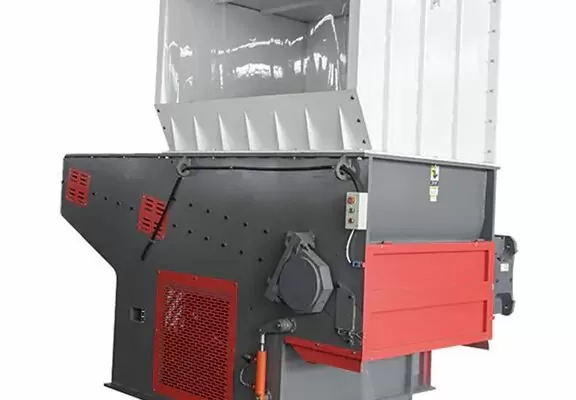
Higher consistency creates greater energy value. Single Shaft Shredder Machine For Waste Cardboard
Why Is Shredding the First Critical Processing Step?
Incoming waste streams are highly variable.
Materials may include:
- Plastic waste
- Paper
- Cardboard
- Textiles
- Wood
- Packaging materials
- Industrial production waste
Without proper shredding:
- Material handling becomes difficult.
- Separation efficiency decreases.
- Drying becomes less effective.
- Fuel quality becomes inconsistent.
The Global Size Reduction Engineering Institute identifies shredding as one of the most influential pretreatment stages in alternative fuel production.
Good fuel begins with consistent feedstock.
Which Shredders Are Commonly Used for SRF/RDF?
Different materials require different equipment.
Common solutions include:
Primary Twin-Shaft Shredders
Ideal for bulky mixed waste.
Provide high torque and excellent resistance to contamination.
Single-Shaft Shredders
Produce more uniform particle sizes.
Excellent for secondary shredding applications.
Fine Granulators
Used when smaller particle sizes are required before final processing.
Choosing the correct machine depends on:
- Material composition
- Capacity
- Final particle size
- Downstream equipment
Why Does Particle Size Matter?
Particle size directly affects fuel performance.
Uniform material improves:
- Drying efficiency
- Magnetic separation
- Air classification
- Fuel feeding
- Combustion stability
Oversized material reduces processing efficiency.
Excessively fine particles may create dust and handling challenges.
The objective is consistency rather than simply making everything smaller.
According to the Alternative Fuel Processing Laboratory, optimized particle distribution contributes significantly to stable SRF production.
Consistency creates efficiency.
Efficiency creates value.
How Does Shredding Improve Material Separation?
After shredding, waste passes through several separation stages.
These may include:
- Magnetic separators
- Eddy current separators
- Air classifiers
- Screening systems
- Optical sorters
Uniform particle size allows these technologies to perform more accurately.
The cleaner the recovered combustible fraction, the higher the fuel quality.
Why Is Automation Essential in Modern SRF/RDF Plants?
Today’s facilities process hundreds of tons every day.
Automation helps manage:
- Material feeding
- Rotor loading
- Motor protection
- Production monitoring
- Alarm systems
- Energy optimization
Modern PLC systems reduce operator workload while improving process consistency.
The Smart Waste Processing Alliance highlights intelligent automation as a major contributor to plant productivity.
Smart control creates stable production.
How Does Energy-Efficient Shredding Reduce Operating Costs?
Energy consumption remains one of the largest operating expenses.
Efficient shredders reduce power demand through:
- Optimized rotor design
- Precision blade geometry
- Intelligent load control
- Stable feeding systems
- Reduced idle operation
Lower electricity consumption improves overall project profitability.
Efficiency is measured not only in tons per hour.
It is measured in kilowatt-hours per ton.
Which Industries Benefit Most from SRF/RDF Processing?
Alternative fuel production supports many industries.
Including:
- Municipal waste management
- Cement manufacturing
- Waste-to-energy facilities
- Commercial waste processors
- Industrial recycling companies
Growing environmental regulations continue expanding these opportunities.
The market extends far beyond waste management.
It reaches the entire industrial energy sector.
How Is AMIGE Supporting Alternative Fuel Production?
At AMIGE, we continuously develop shredding technologies suitable for demanding SRF/RDF applications.
Our engineering focuses on:
- Heavy-duty rotor systems
- High-torque drives
- Intelligent PLC controls
- Wear-resistant blade designs
- Easy maintenance
- Customized particle size control
We understand that reliable pretreatment determines downstream performance.
Every improvement in shredding supports better fuel production.
What Does the Future Look Like?
Alternative fuels will continue expanding as industries pursue:
- Lower carbon emissions
- Reduced landfill dependency
- Improved resource utilization
- Greater energy security
Future SRF/RDF facilities will increasingly integrate:
- AI-assisted monitoring
- Predictive maintenance
- Advanced sorting technologies
- Intelligent shredding systems
Waste will become an increasingly valuable energy resource.
Efficient processing will determine who benefits most.
Conclusion
Shredding technology is the foundation of modern SRF/RDF production. By delivering consistent particle size, improving downstream separation, reducing energy consumption, and preparing high-quality feedstock, advanced shredders transform waste into valuable alternative fuel. At AMIGE, we believe intelligent shredding is not only a recycling solution—it is a key contributor to the future of sustainable energy and the circular economy.
#SRF
#RDF
#AlternativeFuel
#WasteToEnergy
#IndustrialShredder
#PlasticRecycling
#WasteProcessing
#CircularEconomy
#RecyclingEquipment
#AMIGE
