
To clean an industrial plastic grinder, stop production, isolate every energy source, remove loose material with approved tools, open only the manufacturer-designated access points, clean the chamber and screen, inspect the knives, and verify that every guard is restored before restart.
This guide is for industrial plastic recycling grinders and crushers—not household, food or herb grinders. The correct procedure always follows the machine manual, your site’s lockout/tagout program and local safety rules.
I’m Jacky, CEO of AMIGE. A cleaning plan should protect people first, then control cross-contamination, downtime and premature wear. It should never require an operator to reach into a cutting chamber or defeat an interlock.
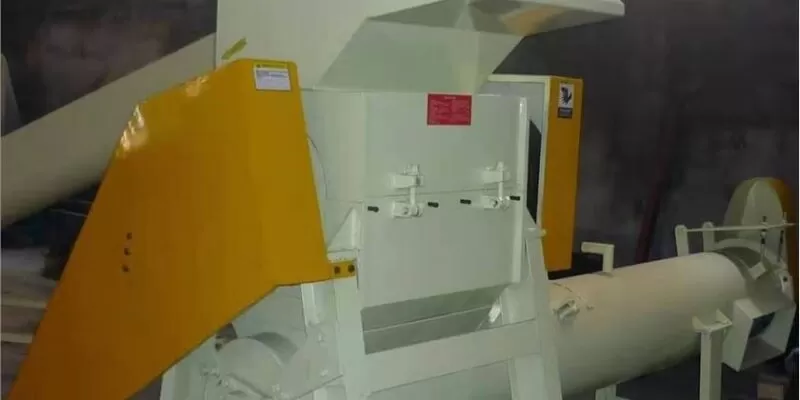
When Should an Industrial Plastic Grinder Be Cleaned?
Clean between resin, color or additive changes when carryover is unacceptable. Also schedule cleaning after wet, dusty or contaminated feed; before a long shutdown; after a jam has been safely cleared; and whenever buildup begins to affect feeding, motor load or output quality.
Do not rely on a calendar alone. Record material, operating hours, contamination, current draw and cleaning time. These observations reveal whether the interval is appropriate for the real duty.
Safety Before Opening the Machine
- Stop feeding and allow the approved shutdown sequence to finish.
- Isolate electrical, hydraulic, pneumatic, gravitational and stored mechanical energy.
- Apply personal locks and verify zero-energy state according to the site procedure.
- Use cut-resistant PPE and tools suitable for sharp knives and contaminated material.
- Prevent unauthorized restart and control access around the open machine.
A stop button is not energy isolation. Large rotors can move unexpectedly, and hydraulic pushers or raised hoppers can retain dangerous energy. Only trained and authorized personnel should perform internal cleaning.
Industrial Plastic Grinder Cleaning Procedure
| Stage | Recommended action | Key risk to control |
|---|---|---|
| Empty | Remove remaining feed with approved tools | Unexpected movement and sharp edges |
| Open | Use designated service access and secure movable parts | Stored energy and falling components |
| Dry clean | Vacuum or brush loose flakes and dust using the site-approved method | Airborne dust and hidden fragments |
| Detail clean | Clean screen, corners, hopper and discharge path with compatible agents | Residue, corrosion and chemical incompatibility |
| Inspect | Check knives, fasteners, screen, seals and bearings | Damage missed during reassembly |
Avoid high-pressure air unless the risk assessment explicitly permits it; it can spread dust and drive particles into bearings or electrical components. Do not use water or solvent on a machine unless the manufacturer approves the method and drainage, corrosion, fire and electrical risks are controlled.
What to Inspect While the Grinder Is Open
- Knife edges for rounding, chips, cracks or embedded metal
- Knife clearance and fasteners against the service specification
- Screen holes for blockage, cracking or deformation
- Rotor and chamber for abnormal contact or material buildup
- Seals, bearings, belts and guards for wear or contamination
- Hopper, discharge and extraction points for leakage
Cleaning is the best inspection window. Photograph unusual wear and record it before parts are replaced. A recurring pattern can point to unsuitable feed, metal contamination, incorrect clearance or unstable feeding.
Restart Checklist After Cleaning
Account for tools, rags and removed material. Confirm that screens, knives, fasteners, access doors, guards and interlocks are correctly installed. Remove locks only under the site procedure, clear personnel, jog or test the machine as permitted, and observe vibration, sound, current and discharge before returning to full feed.
If the rotor contacts a stationary part, an interlock fails, vibration rises or current is abnormal, stop and investigate. Do not use production material to force the machine through a suspected obstruction.
Reduce Cleaning Time in the Machine Specification
Frequent product changes justify quick-access screens, suitable service doors, lifting assistance, simplified residue traps and a layout with safe working clearance. Dust extraction and controlled feeding can also reduce buildup.
Review the AMIGE plastic crusher range when planning a new grinder or replacement. The correct rotor, knives, screen and access arrangement depend on the feed material and required flake.
Information to Send for a Grinder Recommendation
Provide material type, photos, maximum dimensions, contamination, moisture, required throughput, target flake size, color-change frequency, operating hours, current cleaning time, available space and power supply.
Send these details through the AMIGE inquiry form. We can review the material and propose a grinder configuration plus practical maintenance access for the project.
Frequently Asked Questions
How often should an industrial plastic grinder be cleaned?
Base the interval on resin or color changes, contamination, operating hours and observed buildup. High-changeover or dusty applications normally need more frequent cleaning.
Can I use compressed air to clean a plastic grinder?
Only if the manufacturer and site risk assessment allow it. Compressed air can spread hazardous dust and push particles into components.
Can an industrial grinder be washed with water?
Not automatically. Water can create electrical, corrosion and drainage risks. Use it only on equipment designed for wet cleaning and under an approved procedure.
What causes plastic to build up in the grinding chamber?
Heat, soft feed, dull knives, poor clearance, overloaded feeding, moisture and an unsuitable screen can all contribute.
What details help select an easier-to-clean grinder?
Share the material, changeover schedule, contamination, throughput, flake size, cleaning method, site layout and safety requirements.