

Yes, fiberglass can be recycled, but the practical route depends on the resin, glass content, contamination, product geometry and the market for the recovered output. Mechanical recycling reduces cured fiberglass into flakes, fiber-rich material or filler; thermal and chemical routes are specialized downstream processes.
Fiberglass is not one uniform waste stream. Boat panels, pipes, automotive parts, production trim and wind-turbine blade sections can require different cutting, feeding, dust control and separation arrangements.
I’m Jacky, CEO of AMIGE. Before recommending size-reduction equipment, I want to see representative material and understand the customer who will accept the recycled fraction.
Why Is Fiberglass Difficult to Recycle?
Glass fibers are locked inside a cured thermoset resin in many fiberglass-reinforced plastic products. Unlike a clean thermoplastic, the composite does not simply melt back into the same product. Coatings, foam, wood, metal inserts and dirt add further variability.
The material is also abrasive. It can accelerate cutter, screen and conveying wear, while fine glass-rich dust requires controlled extraction and exposure management. These factors must be included in operating cost and maintenance planning.
Fiberglass Recycling Routes Compared
| Route | What it does | Typical decision factor |
|---|---|---|
| Mechanical | Cuts, shreds and grinds cured composite into controlled fractions | Outlet for filler, reinforcement or co-processing feed |
| Thermal | Uses heat in a specialized process to remove or convert resin | Energy demand, emissions control and fiber quality |
| Chemical | Uses selected chemistry to break down the resin matrix | Resin compatibility, reagent recovery and plant complexity |
| Co-processing | Uses prepared composite in an approved industrial process | Receiver specification and local authorization |
The viable route is determined by verified trials and a real offtake specification. Size reduction is often a preparation step, not proof that the material has become a saleable recycled product.
Mechanical Fiberglass Recycling Process
- Identify resin type, reinforcements, coatings and hazardous contamination.
- Remove metal, cables, foam or other items where practical.
- Pre-cut oversized parts into safe transport and feed dimensions.
- Use controlled primary shredding to reduce bulky sections.
- Apply secondary granulation or milling only if the outlet needs finer material.
- Screen and collect fractions under suitable dust control.
Large panels or blade sections may need off-line cutting before the shredder. Feed geometry, thickness and embedded metal can matter more than total weight when selecting the opening and drive.
Selecting a Fiberglass Shredder or Grinder
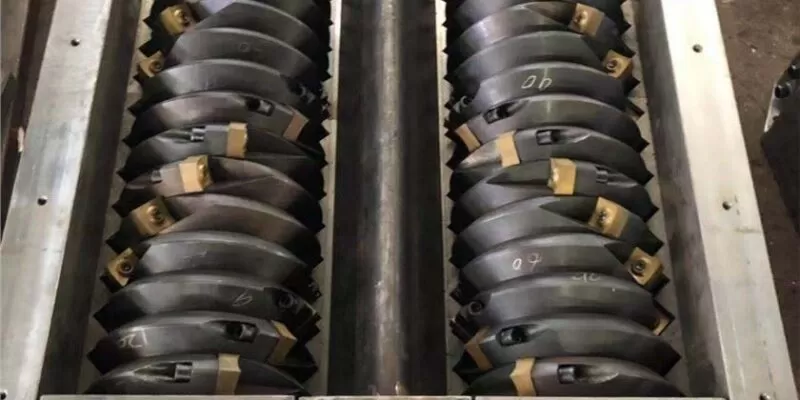
A primary shredder should provide stable feeding, torque protection and serviceable cutters. A screen-controlled single-shaft stage may be considered when a more consistent output is required. Knife material, hardfacing, screen design and replaceable wear surfaces should reflect the abrasive duty.
Review the AMIGE industrial shredder range as a starting point. A material test is needed before confirming capacity, output size, wear rate or the number of stages.
Dust, Wear and Safe Operation
- Enclose transfer points and apply correctly designed local extraction.
- Assess worker exposure to glass-rich and resin-containing dust.
- Evaluate fire and combustible-dust hazards for the complete material mix.
- Keep cutters sharp and monitor clearance, vibration, current and temperature.
- Use safe access, lockout/tagout and lifting methods for heavy parts.
- Collect fines without uncontrolled leakage or secondary handling exposure.
Local environmental and occupational rules determine the required controls. Equipment suppliers, dust-system specialists and the site safety team should coordinate the complete solution.
How to Evaluate Project Feasibility
First secure a credible outlet and its limits for particle size, fiber content, resin, moisture, metals and other contamination. Then test representative batches, measure yield and energy, inspect wear, and calculate disposal costs for unusable fractions.
For equipment review, provide product type, resin if known, photos, maximum length and thickness, embedded materials, bulk density, hourly and annual volume, target size, downstream route, utilities and site layout.
Submit this information through the AMIGE inquiry form. We can evaluate the mechanical size-reduction stage and recommend a trial plan for the actual composite waste.
Frequently Asked Questions
Is fiberglass recyclable?
Yes, selected fiberglass waste can be mechanically, thermally or chemically processed, but feasibility depends on composition, contamination, local facilities and a usable outlet.
Can a fiberglass shredder create reusable material?
It can prepare controlled fractions, but reuse depends on downstream specifications and testing. Shredding alone does not guarantee a marketable product.
Can wind turbine blades be recycled?
Some projects use mechanical, thermal, chemical or co-processing routes. Large blade sections require a planned dismantling, transport and pre-cutting method before plant processing.
Why does fiberglass wear shredder cutters quickly?
Glass fibers are abrasive. Cutter material, edge condition, feed contamination, throughput and required output size all influence wear.
What information is needed to select fiberglass recycling equipment?
Provide the product and resin type, dimensions, contaminants, quantity, target size, downstream outlet, utilities, layout and local safety requirements.
